Creativity is rebellion

Creativity is change. It’s the fresh and new. It’s connecting things that have never been connected before.

Every single original creative act that you undertake is a strike at the status quo of the world.

Ever wonder why being creative is sometimes such a struggle?

Most people set up their whole lives to maintain the status quo and here you come to change things.

Remember that you are a rebel. If you’re trying to sell a really fresh idea, you either have to face this opposition or go underground and release your ideas gradually or pad them in some acceptable way. Find other rebels and join with them.

Anything you do from inventing a new kind of cupcake to decorating your house with 100 preserved owls is going to challenge people. They are going to call you stupid, wasteful and a dreamer.

No matter how small, truly creative acts are rebellious. Stand strong, you are not alone.

Conspiracy and creativity

Screen Shot 2017-08-20 at 8.28.57 PMPeople who see connections between events that other people don’t see are considered conspiracy theorists. This conjures up images of unkempt men in dark rooms with filing cabinets full of “evidence” that they post on their websites to prove that their view of reality is the TRUTH! Obviously the Earth is controlled by reptilian aliens that live in tunnels underground and the moon landings were faked.

Really, the human brain is a machine that looks for evidence to prove what it already believes. You take in new information and store it in relation to old information.  Creativity is making connection between unlikely bits of information where none existed before. When you are creative, you are relating previously unrelated ideas to one another.

Creative people are conspiracy theorists that are less concerned with the past and more concerned with the future.  What ideas can we, as creative people, come up with now that will cause the future we want to live in?

This can be as simple as a reality where you have a lot of money or as complex as some kind of Utopian society where everyone immortal.

What conspiracy can you put in motion now that will make the future amazing? What new connections can you make that will expand what it means to be human? What decision can you make today that someone 100 years from now will point to as a turning point in human history?

Don’t use your brilliant mind to look for evidence of alien interference in history or Nazi moon bases.

Instead, create new conspiracies, the kind that make things better.

If you are a reptilian alien and reading this, ignore the plea to create a new reality, you guys have already done enough.

Managing talented, smart people

Did you ever read something, have it stick in your head and then not remember where you read it?

Well, it happened with me and this essay called, How To Manage Smart People by Scott Berkun. I read it years ago and quoted it to lots of people, but couldn’t remember the source. Then, a friend who knew I was looking for it, emailed me a link. Now, I pass it on to you.

It’s full of great advice about managing people who are smart and talented, but it had one question that stuck in my head. It suggests that the best question to ask your brilliant talented employee was, “What do you need from me in order to kick ass?”

For most of us, in our creative lives, we are our own managers. We decide how we work and where and what we work on. Have you ever asked yourself, what do I need from me to kick ass? Then seriously tried to answer it?

It might be something simple like easily accessible caffeine or more time alone. Or, it could be more complicated and emotional. In any case, it’s one way to help yourself live up to your creative potential. And, if you manage creative people, a great question to ask them as well.

What do I need from me to kick ass?

Read the essay here

Crazy and creativity: is there a connection?

Do you have to be mentally ill to be creative?

Psychology Today doesn’t think so. This article points out that most people think coming up with the idea the hard part, but truly creative people know that’s not true.

So what does matter?

Persistence. Hard work. Trial and Error. Skill. The ability to tell a good idea from a bad idea.

Here are a couple of quotes from the article:

Psychologist Mihaly Csikszentmihalyi, best known for his work on flow, has spent four decades studying the creative process. He recounts the experience of sculptor Nina Holton. “Tell anybody you’re a sculptor and they’ll say, ‘Oh, how exciting, how wonderful,'” Holton told him. Her response to such comments: “What’s so wonderful?” Then she explains that being a sculptor is “like being a mason or a carpenter half the time.” She finds that “they don’t wish to hear that because they really only imagine the first part, the exciting part. But, as Khruschev once said, that doesn’t fry pancakes, you see. That germ of an idea does not make a sculpture that stands up. So the next stage is the hard work. Can you really translate it into a piece of sculpture?”

And this delicious nugget:

“If the writer doesn’t sit at the computer every day,” he points out. “The muse is not going to visit.”

What are people talking about right now?

Need a topic to write about or random thoughts to get your brain working? Why not ride the wave of the fickle attention of the American public? Here are couple of ways to get access to what people are thinking about and talking about right now!

Google hot trends
gives a constantly updated list of what people are searching for on Google. For instance, today people are searching for “On Golden Pond”, “Juanita Bynum” and “High School Musical 2 dance along.” Just combining those three things could provide you with a wonderful plot to a short story. Or a show on the Disney Channel about growing old and spousal abuse.

You could also check out what people are dreaming about. Dreamjournal has a number of interesting ways to view the symbols and plots of a large sample of dreamers. Here is a bunch of charts to show you what dreams are popular right now.

In any case, if you aren’t getting anywhere with what’s in your own head, try using what’s going on in everyone else’s.

Stop creative blocks, never psychoanalyze what you create

There is a lot written about how to recover from writer’s block and every other kind of creative block, but very little has been written on how to prevent it. Here’s one cause of writer’s block you can be conscious of before it happens.

From the time we are very little, we are taught that art has hidden meanings and reveals things about us to clever observers. In fact, these days it’s possible to get kicked out of school for handing in a horror story for a creative writing assignment. The truth is very different. If writing a horror story indicated a tendency for violent behavior, wouldn’t the police interview Stephen King and Clive Barker every time there was a brutal killing?

Don’t judge what comes out while you create. Don’t worry about what other people will think. If you start down that path, it will be start a crippling block that will limit your creativity to creating Hallmark Cards and those terrible jokes in Reader’s Digest.

You are not what you create. What you create is not wish-fulfillment for how you feel the world should be. Better to let out the emotions you don’t want in your life in your art. Never look at what you’ve done and say, if I show this to anyone they’ll think I’m crazy or that I hate my mom or that I have huge anger issues.

There will always be people judging you based on what you create, but they all already think you’re weird for trying to create something in the first place. I find, often, that criticism reveals more about the preoccupations and fears of the critic than of the art they are criticizing.

Creativity tip: do your worst!

Screen Shot 2017-08-20 at 8.22.38 PM

Shooting for the top can be exhausting, why not spend some time settling for the gutter? Instead of trying to write a good story, write the hackiest one you can. Paint something that would make a high school art class shudder with disgust. Shoot for the bottom!

Making bad art on purpose can make you better at what you do. It lets you burn off all the ideas and bad habits you have in a bonfire of mundane crap. You can identify all the mistakes you can make and then, when you make them again, they will be as obvious to you as a giant rabbit dressed as Abraham Lincoln standing in your breakfast cereal. Once you make the worst you possibly can, you can stop yourself from ever doing it again.

I found a great example of this today, cartoonist Anthony Clark was challenged to draw 200 “bad” cartoons and he did. They are fun to read just so you can spot all the different ways comics can be bad. Of course, some of them are really funny as well.

Use your worst to help you get to your best!

link to 200 “bad” cartoons

Warm up for being creative

If you are going to exercise, you have to do some stretches to warm up. You don’t just throw your body into high gear immediately.

Why don’t we warm up for being creative?

I think some of the same physical warm ups are useful. Taking a walk or stretching before you start working definitely gets the blood flowing. Treat it like it’s a physical activity and you’ll find yourself more alert and focussed.

Then, there warm ups you can do with your brain. These are more personal. I know people who mentally warm up for the day by doing a crossword puzzle. Other people read a few chapters of a book or doodle on a pad.  I even know  one person who makes up  new nicknames for politicians that make him angry as he listens to the news on the way to work.

I find for me that talking to other people is an important part of starting to communicate. I tend to start the day inside my head and I need something to pull me out.

What warm ups work for you?

Forget common sense: creativity tip

Common sense is a good way to live your life. It keeps you away from dangerous people and dangerous situations when the stakes are high. It helps you to survive.

But common sense is a terrible thing to carry into your creative life. In fact, the best stuff runs completely counter to common sense. Common sense is sticking with what you already know works. Common sense is avoiding the unexpected.

Do you have a voice in your head, an authority figure of some kind, that tells you what to do to stay safe? Most of the time, that voice is useful, but when you enter into a situation where you’re trying to come up with something new it stop you in your tracks.

What you should do is thank the voice for being so helpful, but tell it you don’t need it right now. Then, wander into dark wilderness of your mind. There are wolves and terrible things there and you never know what you might find when you wander off the path. In fact, it’s completely unpredictable and new.

And isn’t that what you really want?

Make a magic object! Creativity tip

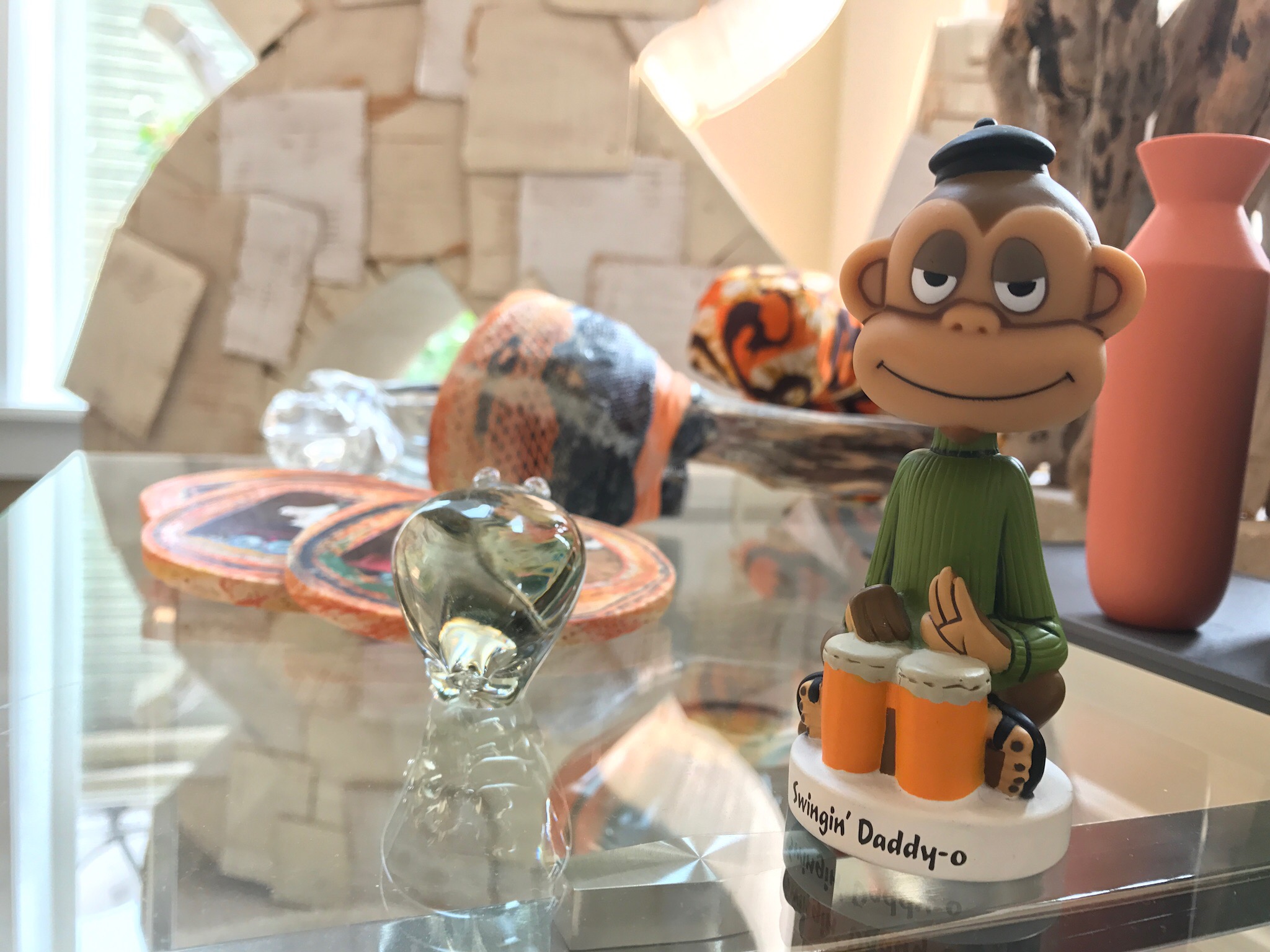
Monkey Beatnik
I learned this tip from a friend.

We were working a book together, at his place, and before we started he turned to a monkey bobblehead on his desk and said, “Ready to go?”

“Are you talking to that monkey,” I asked.

“Of course,” he said, “that monkey helps me out.” He wasn’t even embarrassed about it, he said it like I was stupid for asking.

It turns out that everywhere he works he has a different toy, in his case all of them are monkeys, that he talks to before he starts work and then thanks when he’s done. It’s like he has created a magical creativity token for himself. He gives the monkey credit for the ideas, keeps all the money for himself, and when he’s stuck for ideas he pays attention to the monkey for a bit until an idea comes to him.

He uses all monkeys, but he claims that it works with any toy that has a face.

Here are his steps toward creating your own magic object.

1. Find an object with a face. It doesn’t have to be a toy, it could also be a statue or some other sculpture. Just make sure it has eyes you can look into. If you are religious, you can even use a religious statue of some kind. In fact, the more belief you have in it increases its usefulness.

2. Give the object a prominent spot in your workspace. Somewhere you can see it and reach out and grab it is best.

3. When you start working, acknowledge the object in some way. You can touch it, talk to it or just look at it. Just make sure that this become part of the ritual.

4. Although he didn’t do it in front of me, he also talks to his monkey. If you are stuck, ask your object for the answer. I’m not sure how it answers, we didn’t get into that.

5. Last, and most important, thank it when you’re done. Even if you don’t think your version of the monkey has done anything, thank it. According to my friend, this helps relieve the burden of starting the project again. Instead of having to remember where you were, all you have to do is go back to the monkey and pick up where you left off. This completes the cycle and lets you walk away with no weight on your shoulders.

I haven’t tried this tip yet, but my friend tells me it works wonders. In fact, he says a lot of people do it without realizing it. If you look at artist’s and designer’s workspace, you’ll always find at least one fun object with a place of prominence.

If nothing else, this will give you an excuse to go shopping for toys.