Inattentional blindness – see the gorilla!

p172qjb053nak1akh1bdd1hl9jgn0_20249

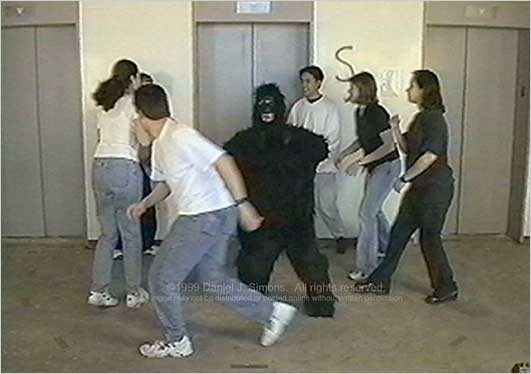
Inattentional Blindness got a lot of media attention last year. It’s the idea that if we lack an internal frame of reference for something it is more than just confusing, our brain actually refuses to even see it. In other words, if you aren’t expecting to see something, you literally won’t see it even if it’s right in front of you.

In the original experiment, people were shown a video of people passing a basketball back and forth and told to count the number of passes. In the middle of the video, a person in a gorilla costume stepped to the middle of the screen faced the camera and then left. After watching the video, the participants were asked if they saw anything unusual and 50%(!!!) of the people did not report the gorilla!

Think about that, half the people didn’t notice a person in a gorilla suit. Everyone I’ve talked to about this says that, of course, they would have seen the gorilla. But, aren’t there obvious things we all miss all the time?

Sometimes, an idea or solution is standing right in front of you, but no one is seeing it. What if you, when faced with a problem, train yourself to look for the gorilla.

If everyone is focussed on the top of a problem, look at the bottom. Look for the gorilla! In fact, if everyone could see the gorilla, you wouldn’t need to be there.

If you know there’s a gorilla wandering around and you can’t see it, call someone else in to look for it. Remember half the people couldn’t see it in the experiment, finding someone with a different perspective might make it more visible.

Isn’t a new idea just a gorilla that no one has seen before?

Einstein On Creativity

Einstein_laughing

Here’s a collection of  Albert Einstein quotes on creativity and imagination. Some merely exalt imagination’s importance, but there is also good advice. My favorite is the idea that the question you ask is more important than the answer.


If at first, the idea is not absurd, then there is no hope for it.

We can’t solve problems by using the same kind of thinking we used when we created them.

The true sign of intelligence is not knowledge but imagination.

Logic will get you from A to B. Imagination will take you everywhere.

The important thing is to not stop questioning. Curiosity has its own reason for existing.

The only thing that interferes with my learning is my education.

Imagination is everything. It is the preview of life’s coming attractions.

I am enough of an artist to draw freely upon my imagination. Imagination is more important than knowledge. Knowledge is limited. Imagination encircles the world.

Anyone who has never made a mistake has never tried anything new.

The most beautiful thing we can experience is the mysterious. It is the source of all true art and all science. He to whom this emotion is a stranger, who can no longer pause to wonder and stand rapt in awe, is as good as dead: his eyes are closed.

The mere formulation of a problem is far more essential than its solution, which may be merely a matter of mathematical or experimental skills. To raise new questions, new possibilities, to regard old problems from a new angle requires creative imagination and marks real advances in science.

Creativity as commodity

Money Magazine recently featured an interesting article on creativity. The author suggests that since American can no longer compete when it comes to manufacturing the least expensively produced products in the world, we should change our focus to creativity and innovation.

He points to Google as an example. After all, Google produces so many products, so quickly, it’s impossible to keep up with them. Don’t all the best companies have legions of fans waiting to see what they do next?

I agree with him. Gone are the days when one good idea is enough to build and maintain a fortune or a company can exist that sells a single product unchanged for decades and remain a market leader. Shouldn’t the question always be, “What’s next?”

What he implies, but doesn’t say, in the article is that most companies don’t just not value creativity, they despise it. They focus all their energies on solving momentary problems (putting out fires), refining their hierarchical structure and worrying about why customers aren’t as interested as they used to be. Not to mention that they have to be tricked into learning about creativity by consulting companies who call it “management techniques.”

Creativity is change. Change is scary. Change is something businesses only want when they are in deep trouble.

That said, the business I work for premiered the Electronic Yodelling Pickle today, which Nerd Approved declared to be “The Product Of The Century.”

Google should be very afraid.

The power of nicknames: creativity tip!

This may seem like a silly tip, but I swear it works.

Give yourself a secret nickname. This is going to be like your super-hero identity for creativity. For instance, perhaps you could call yourself “Genius Pants.” Now, when you need an idea fast or you start to get stuck, just say to yourself, “What now, Genius Pants?”

Once you do this, it activates a whole other part of yourself. The part of you that is energetic and eager to please. The part that is brimming with ideas! Great ideas!

Then, after you’re finished, just say, “Thanks Genius Pants, you are awesome.”

The first step is to choose your nickname. I recommend having more than one word in your nickname. The first word can either be a positive adjective, like “genius” or “amazing,” or a title of some kind, like “princess” or “mister.” Then, the second word can be any noun or another positive adjective.

It can also be fun to add a “Mc” to the front of the second word.

Here are a few samples:

Princess McSparkles
Magic Racecar
Sergeant Playmobilecastle
Kid Genius
Awesome Sequins
Colonel Jellybean
Rebellious McCupcake

Pick a stupid name, but a name you like. Don’t tell anyone. Sharing it will make it work less. It’s a nickname for you to use for yourself.

If you come up with one that you aren’t going to use, just leave it in a comment. You might be helping someone else.

Stare Proudly: Creativity Tip

I came across a quote from Flannery O’Connor that inspired this post. She said, “The writer should never be ashamed of staring. There is nothing that does not require his attention.”

I don’t think this applies to just writers, but creative people in general. It’s only through close examination that you can get past the surface and figure our what’s really going on inside of anything. This sometimes requires us to look at someone a little bit too long or to pay too much attention to a conversation at the table next to us. We might ask our friends questions that seem too probing or they catch us going through the mail they left out on the table.

Society might judge us rude, but this observation is crucial.

Don’t be ashamed of noticing the world around you. Stare, listen and ask questions. Sometimes you’ll get caught and confronted, but this won’t happen often. Don’t give it a second thought. Drink in the world in loud, gigantic gulps.

Stare proudly. The information you take in is the fuel for what you produce.

Is creativity killing the culture?

The Twin City Daily Planet posted an article by Michael Fallon, one of their critics, called How creativity is killing the culture. In it, he suggests that encouraging everyone to be creative has resulted in “a nation of navel-gazing dreamy-eyed so-called creatives who no longer
consider it worthwhile to roll up their sleeves and get down to hard
work to get a job done, or, even worse, who no longer deem it worth
their time to bother checking out any of the stuff that anyone else has
made.”

Obviously part of the point of the article is to start discussion (flamebait) more than I think he’s really serious. In truth, it seems like he’s burned out with his job and is tired of going to gallery shows by bad artists.

The meat of his argument is that people shouldn’t show bad art to an audience. Two hundred years ago, most of the creativity you would come in contact with was probably pretty bad. The art you would see and the music you heard was produced by local artists. Only the great art survived, so it seems as if they were better than now. Then, when performances could be recorded and art more easily distributed, there was a time when a very select group of editors and writers decided what was good and what should be seen. Now, the role of the critic is being diminished in value and that probably hurts if you’re a critic.

Today, you have access to music and movies that would never have made it to mass distribution even twenty years ago. Is there a lot of bad stuff? Of course. I haven’t seen an increase in the number of bad gallery shows here in Seattle, but the competition has increased.

I agree with him that I see a trend amongst creative types to not pay attention to what is being created by others. Great writers read, great chefs eat at other restaurants, great musicians listen to music, if you aren’t an avid consumer of something, why would assume that you would be able to create it?

But, I say if you get pleasure from creating, by all means create – just don’t assume you’re producing something of interest to others. If you do want to share it, be prepared to be ignored. Even if you produce something great, be prepared to be ignored or dismissed. So has it been, so shall it be.

The rush to creativity has increased the amount of art produced, but I don’t think the percentages of good to bad art has changed. There is more good art, there is more bad art.  That means critics have a numerically larger number of artists trying to get reviewed and a larger number of bad artists.

I’m going to include one more paragraph that to me seems to describe the way the world has always been. There was no magical time of fantastic art in the past.  It has always been extremely easy to create something and extremely difficult to create something great.

From my vantage point, the zero-sum creativity spiral has some
strangely counterintuitive and dreadfully harmful results. Most
worrisome among these is the fact that the constant lip service to
creativity leads to the creation of more and more stuff—art and music
and writing and the like—that is actually not very creative,
uninteresting, of poor quality, and off-putting to any potential
audience. This may seem an impossible thing to stem from such a
feel-good sentiment—more creativity must mean a better world,
right?—but the problem is that more emphasis on creativity means less
emphasis on what it is precisely that makes art good. It’s not the
simple act of making—of creating something, anything—that makes art.
It’s the application of craft, dedicated practice, careful thought,
hard work, and artfulness that makes art. Real creative art is a rare
and precious thing and this will likely always be so.

I guess, to him, it would be better to discourage creativity. That way, he would have far fewer artists to deal with.

Read the article here
Kurt Vonnegut – Where Do You Get Your Ideas Part 5

Kurt Vonnegut’s answer when he was asked, "Were do you get your ideas?"

Where do I get my ideas from? You might as well have asked that of Beethoven. He was goofing around in Germany like everybody else, and all of a sudden this stuff came gushing out of him.

It was music.

I was goofing around like everybody else in Indiana, and all of a sudden stuff came gushing out.

It was disgust with civilization.

Quote via devilduck

Creative compound interest

It’s easy to get caught up in the search for the next big idea, but don’t disregard finding an improvement for an existing idea.

A simple 1% improvement to an existing project might not seem like a lot, but if you continue to find small improvements, it eventually becomes something completely different. In fact, using this attitude everywhere in your life can help you develop a constant creative outlook.

Most people only focus their energies on things that are broken, but why not focus on improving things that are working? Don’t wait for a problem, make it your attitude to always be improving.

For writers, editing and rewrites are built into the project. A hundred tiny changes can turn something mediocre into something great.

It’s just like compound interest for a bank account. These tiny improvements don’t just add to an idea, but add to the principal and earn more interest with each new improvement.

Businesses use the Japanese philosophy Kaizen as a model for improving themselves. Some people find this kind of structured gradual improvement to also be helpful in developing their personal skills.

Mr. Rogers quotes on creativity

Here are a few quotes from Fred Rogers, host of children’s show Mr. Roger’s Neighborhood, on creativity from the book You Are Special.

There would be no art and there would be no science if human beings had no desire to create. And if we had everything we ever need or wanted, we would have no reason for creating anything. So, at the root of all art and all science there exists a gap – a gap between what the world is like and what the human creator wishes and hopes for it to be like. Our unique way of bridging the gap in each of our lives seems to me to be the essence of the reason for human creativity.

When people help us to feel good about who we are, they are helping us love the meaning of what we create in this life.

Play is the real work of childhood.

Grown-ups are often puzzled by children’s play because we don’t fully understand, but a child needs the freedom to play what we don’t always understand.

Some toys make children conform to them. They are not objects that children could make conform to their own fantasies and feelings. The time spent making those toys work means less time spent in the kind of play young children need most — pay of their own invention.  There is a big difference between toys that we can adapt to our own inner needs and toys that make us adapt to them.

I’ve often hesitated in beginning a project because I’ve thought, “It’ll never turn out to be even remotely like the good idea I have as I start.” I could “just” feel how good it could be. But I decided, for the present, I would create the best way I know how and accept the ambiguities.

Often the creative urge, once we express it, brings real relief in whatever form it takes. We have an inner sense that we can make what is into what we feel could and should be.

Imagining something may be the first step in making it happen, but it takes real time and real efforts of real people to learn things, make things, turn thoughts into deeds or visions into inventions.