Unlimiting creative limitations

Most creative people are familiar with their limitations. They know that they aren’t great at drawing noses or they are self-conscious about their ability to write dialog. But, if you look at the people whose work you enjoy, aren’t their limitations one of the reasons you enjoy them?

Liking a work of art is a lot like having a friend. You have standards for friendship, certainly, but you don’t expect your friends to be perfect. In fact, you probably like your friends more because of their faults. Maybe you share a similar fault and it makes you more familiar. Maybe you make up for one another’s faults and can depend on one another to make each other better.

If you make the same mistakes repeatedly and anything you repeat becomes a pattern, then patterns in your work are what constitute your style. So, your limitations are a big part of your style.

As long as you recognize the flaws and present what you do well confidently, your audience will find you. And who knows, some of them may love you more for your imperfections.

David Lynch On His Creative Process

DL_400x400

David Lynch commenting on how his ideas come together. I have experienced the same process with a central idea serving as a magnet for all the other ideas:

Sometimes if I listen to music, the ideas really flow. It’s like the music changes into something else, and I see the scenes unfolding. Or I might just be sitting quietly in a chair and bing! – an idea will hit me. At other times, I might be walking down the street when I see something that’s meaningful and inspires another scene. On anything that you start, fragments of ideas run together and hook themselves up like a train. Those first fragments become a magnet for everything else you need. You may remember something from the past that’s perfect, or you may discover a brand new thing. Eventually, you get little sequences going. Before you think of anything, the whole landscape is open. But once you start falling in love with certain ideas, the road you’re on becomes very narrow. If you concentrate, ideas will come to that narrow road and finish it.

Creativity tip: be honest

People often think of creativity as making something up. Making something up is also how people describe telling a lie.

Instead of putting all that effort into making something up, the next time your stuck just tell the truth. Set aside the idea of trying to please other people or trying to appeal to them.  Be completely honest with yourself.

It isn’t easy to be honest, but certainly it’s less effort than making something up.

Once you know how you feel about something, you can start to decide the best style to express it.

The truth will make you unique. Trying to say what you think people want to hear will make you mediocre.

A quick summary of every book about succeeding in business

Have an idea.

Pursue that idea with every ounce of will and strength you have.

If you don’t succeed, take what you’ve learned and apply that to the idea. Make the idea better and try again.

Repeat until you succeed.
———————————————
I was talking to a friend of mine and she compared succeeding  (in acting and writing but I think it applies to everything) to hitting your head against a brick wall until you finally break through it. Most people just coexist with the wall and learn to lean against it for support. That wall is a great excuse for staying right where you are.

But, she said, it’s totally worth it to keep slamming against it. The people who make fun of you for doing it are going to be asking you for work as soon as you get to the other side. They’ll also be talking about how much smarter they are than you and more talented and how they deserve what you have. But it doesn’t matter, because you’ve already found another brick wall and you’ve already started slamming your head against that.

Repeat.

If you want success, especially financial success, learn to love slamming your head against that brick wall!

Obsessed with giants: Frederick William of Prussia

Screen Shot 2017-08-05 at 8.18.22 PMA King obsessed with giants so deeply that he had an entire regiment of them in his army? I saw a brief reference to King Frederick William’s obsession with giants in a book I was reading about circus sideshows and immediately had to track down more information. How could I not have heard of the Prussian ruler who had an entire regiment of giants? It sounds like a fairy tale, but it’s true.
There are plenty of references available on the web, but the most complete I found was this one. Frederick it seems collected giants to be in his special giant regiment, the Potsdam Grenadiers. He would send agents to other countries searching for giants and offer them great sums of money to come and join his unit, if they refused he would often order them kidnapped.

His obsession made him the laughing-stock of most of the royal houses of Europe. His judgment was so clouded in this area that he would bring his nation to the brink of war while attempting to kidnap a seven-foot tall man from another country. In fact, other countries could easily gain his favor by presenting him with a gift of giants. The poor giants were paid well, but there were many attempts at desertion and suicide as they were separated from their homes and families.

To get around the trouble caused by his illegal giant activities, Frederick hit upon another idea. Instead of capturing them, he would breed them. He then started forcing the tallest men in his kingdom to couple with the tallest women to produce giant babies. Of course the effects were not immediate, but in a couple of generations there was a much larger proportion of giants in the city of Potsdam, especially very tall women.

In his deluded way, Frederick loved his hundreds of giants. He spent hours drilling them into one of finest precision military units in the world. They were dressed in expensive and detailed military uniforms topped off with tall red caps. He could paint their faces from memory and often did. In times of deep depression, he would have them march, preceded by their huge bear mascot, through his room to cheer himself up. It is said he treated them as a boy might treat his toy soldiers, and at five foot five, he was proportionally a child in their presence. Draw your own psychological conclusions.

Click here to read more about this fascinating story

Risk and creativity: a helpful lie

In improvisational acting there is an often quoted sentiment, “Jump and a net will appear.” The idea being that if you take a big risk, the rest of the players and the audience will catch you and make you look good. You won’t look foolish. You won’t stick out like a sore thumb. The very fabric of reality will bend to make you look great.

There is a secret to this statement. I could list a bunch of instances where it has been true. Someone took a huge risk and it paid off even though they had no idea how it would work out. The universe conspired to make them look brilliant. But, the secret is that the statement is not always true. Taking risks is, by definition, risky.

However, if you want to accomplish anything or create something interesting and exciting, you have to act as if it is true. That’s right, it doesn’t matter if you believe it or not as long as you act like you believe it. Acting as if it were true will make you happier and give you a better life.

Now, if you’re like me, you’ll have trouble using obviously false statements to drive your behavior. Here’s the modified, and less catchy, phrase that lives in my head. “Jump and a net will probably appear. If the net doesn’t appear, the consequences are still less than what they would be if you never jumped at all.”

Truthfully, promising you the net is just a way to get you to jump. If you don’t jump, nothing will happen. So, jump into the abyss. If the net doesn’t appear, jump again into the next deeper abyss. Eventually you will be caught and lifted higher than you’ve ever been before.

And that, to me, is 100% true.

Lost art: the corporate musical

6a00d83451c29169e200e54f10b6608833-800wi

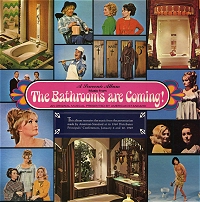
Over on the WFMU Blog they have been chronicling a lost art form. The corporate musical! These were musicals created by large companies to help charge up their sales force during conventions. They hired professionals to do it and those professionals obviously have no passion for the subject. It’s a great example of overcoming obstacles and having to create without inspiration.

What would you do if you had to write an entire musical about bathroom fixtures? Probably something like The Bathrooms Are Coming. Not only does it contain the best (only?) song about bathroom fixture distributors ever written, but also the best song about how a woman feels about her bathroom.

My bathroom
Is a private kind of place
very special kind of place
the only place where I can stay
making faces at my face

How about a calculator company? Here’s the Monroe Calculator Company musical, It’s a Brand New Ball Game. Or JC Penny’s Spirit of 66! Which include the great song, How Would We Look Without Zippers? Or the most complicated corporate musical, General Electric’s Go Fly A Kite! It includes a trip to hell and the song Big Fat Wife and Make a Woman Out of Your Wife. This post is a potpourri of different companies, my favorite is the song from the point of view of a salesman’s wife called My VIP, a creepy appreciation from a neglected wife.

We’re those things called salesman’s wives
We gave up living when we chose our lives
But one truth stands, it will always be
We love those men, our VIPs.

Oh, and the Frito Twist.

I don’t know about you, but sometimes there is nothing more inspiring than something completely uninspired.

Best productivity tip: disable your inner-critic

Screen Shot 2017-08-05 at 5.10.45 PM.png
There was a challenge at instigatorblog to write your best productivity tip and link to other tips you felt were helpful.

My best tip is to…

Turn off your inner-critic for the first pass: When you are writing or sketching or designing something, let yourself do a quick first pass at it without criticizing it. Let your mind wander and be free. Once you have a complete rough, it’s much easier to go back and edit something toward perfection than it is to try to create something perfect the first time through.

Don’t be paralyzed by perfection!

After you’ve written your first draft, let your critic go crazy on it until it is good enough.

I wrote about a metaphor for this idea, the one I use, in The Two Faces of Creativity, Orson and Ed.

Here are links to some more great productivity tips.

Unplug! From Daily Blog Tips
Have fun! Kiss2


Creativity tip: work fast

This is a tip for the kind of person that starts a project, but fizzles out before it’s finished. Work fast!

You can bypass your inner-critic and unleash your inner-Ed Wood by just getting your product out as quickly as possible in one giant unfinished lump. Don’t think. Don’t edit. Don’t stop to reimagine the whole thing.

Not only will it help you get a project, at least a first pass at the project, done quickly, it will clear out your brain so other ideas can take their place. Then, after a period of time, you can go back and start the editing process. This works with illustration, writing and even dance.

There are lots of events designed to help you accomplish working quickly. Probably the king of work fast, edit later is nanowrimo (National Novel Writing Month). They give you the month of November to write a  50,000 work novel. They don’t care about quality, just quantity. I know a few people who have only finished novels because they participated.

In June, they are working a new project called Script Frenzy! The idea is that you, or you and a partner, write a 20,000 word screenplay or stage play during the month of June. If you’ve been putting off writing your screenplay, sign up for this event. It’s free, they send you emails to inspire you and you can get a community of people to commiserate with.

I once had a writing teacher that said you needed a four-foot high stack of terrible stories before you produced anything worth reading. If nothing else, this will give you another inch toward that four feet!

Becoming Creative: 6 Easy Steps Toward Becoming Creative

51caf4ff8f7d2c077d5f4809e8496690 First, I’ll state the obvious. Everyone is creative. There is no person on this Earth that is incapable of coming up with a new idea. However, our entire educational system and most of our culture is set up to squash creativity out of you. Don’t try to learn how to be creative, just remember how to be creative.

When we were kids, we were able to make connections and come up with ideas that are inaccessible to adults. How do we unlearn the bad habits that cut off that part of our brain? Here are 6 simple tips that will push you toward becoming the passionate, creative person you were born to be.

1. Lower your anxiety level. Fear, insecurity and stress are all creativity killers. Do you have some issue or worry in your life that you could easily solve? It doesn’t have to be a big issue, take care of little things. Make sure your car never gets below a quarter tank of gas so the empty light never comes on. Avoid caffeine or other stimulants. Breathe deeply. Meditate. Take care of little problems before they become big problems. The less anxiety you have, the more you’ll be able to focus on being creative.

2. Ask more and better questions. Asking questions is the keystone of creative thought. The only way to get something new is to question the old. Every time you ask a question you force yourself to consider other perspectives and question your own preconceptions. Don’t rely on other people’s answers, figure it out for yourself. Here are some questions to get you started: How can I make this better? Why do we do it this way? Why am I the greatest human being ever to exist?

3. Try new things. Do something that you have never done before. This can be as extreme as finding a new job or as simple as trying Indonesian food. Read a book on a topic you know nothing about. Strike up a conversation with a stranger and ask him/her about his/her past. Trying new things will expand your references and perspective. Finding new ways of looking at the world increases the value of what you already know by letting you find new uses for it.

4. Figure out what you love doing and what makes you happy. This should be an easy task, but some people can’t list more than two or three things. Shouldn’t you be able to fill up a full sheet of paper, both sides, with things that make you happy? If you can only come up with a few, focus on finding more. Your creativity follows your passion and happiness. Artistic expression is its own benefit. It’s the rare artist that makes a living from his art, so passion and happiness are the only two real reasons to create.

5. Forget about your lame excuses. Really, stop with the excuses. They are all lame. There are many people who have it worse than you do that manage to do incredible things.

6. Actually do something. This is the step that completes the transformation of the old you into a creative person. Thinking about doing something doesn’t make you creative. Talking about doing something won’t do it. The only way to become a creative person is to actually create something. This is the only step that matters. Pick up that pencil and draw! Write! Dance! Carve a robot from a bar of soap! It doesn’t matter! DO IT NOW!