Choose your avatar!

Screen Shot 2017-08-05 at 7.41.11 PMThe New York Times posted a few pictures from the book Alter Ego: Avatars and Their Creators. The concept behind the book is to show real people and the characters they create to represent themselves in video games. It’s a real insight into people to find out how they would choose to look.

How would you choose to look? I think it’s valuable to know what you look like to yourself in an idealized form. Do you look the same? Are you covered with armor? Are you sexier? Would you just accept all the defaults that were given to you?

It’s worth thinking about, these characters accomplish a lot, most more than the people that control them. Imagine if the confidence and skill people had with their characters translated into their lives. If you could create a visual image of yourself when you were at your most creative, what would it look like? Could you become that character?

In truth, are you yourself or your avatar?

Be inconsistent today

Screen Shot 2017-08-20 at 8.23.22 AM.png

Today, try and do something inconsistent with your regularly established behaviors. It can be as small as choosing a different brand of soda than you usually drink. Or, as big as endorsing a political candidate from an opposing political party. Do it front of someone who will notice.

People get frozen into their reality because they are afraid to appear inconsistent even when their consistency hurts them. They would rather suffer than to have other people see them change their mind or challenge their own image of themselves. Don’t be so attached to the status quo that your world never grows. How many decisions have you made that limit your world instead of allowing you to experience more of it?

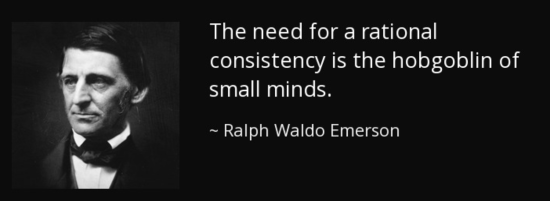
If called upon to explain yourself, quote Emerson. Because then you appear smart and inconsistent. A great combination.

A foolish consistency is the hobgoblin of little minds, adored by little statesmen and philosophers and divines. With consistency a great soul has simply nothing to do. He may as well concern himself with his shadow on the wall. Speak what you think now in hard words and to-morrow speak what to-morrow thinks in hard words again, though it contradict every thing you said to-day.–“Ah, so you shall be sure to be misunderstood.”–Is it so bad then to be misunderstood? Pythagoras was misunderstood, and Socrates, and Jesus, and Luther, and Copernicus, and Galileo, and Newton, and every pure and wise spirit that ever took flesh. To be great is to be misunderstood. . . .

I do my best thinking in the shower

Two people told me today that they do their best thinking while they were in the shower.

If I did my best thinking in the shower, I’d be pretty darn clean because I’d double or triple the number of showers I take. It’s such an easy thing to do, why not take a shower every time you need to ponder something.

Where do you do your best thinking? Is there any way to expand that time? Could you recreate the mind state of when you’re at your best? What about that place makes it so conducive to thinking?

Is there any way you could take a shower all the time?

Waste some time: creativity tip

This weekend, set aside a half hour to completely waste. The only limitation is that you have to waste it actively instead of passively. Don’t watch TV or listen to music or nap on the couch, waste it doing something impractical.

Use the time to imagine the stupidest, most foolish idea you possible can. Use it to sew a windbreaker for a monkey complete with tail hole. Write a proposal for the worst movie ever. Break new ground in hot dog technology. Solder a stained glass Pauly Shore.  Make up an imaginary friend who gives you bad advice. Come up with a reality show idea that would only appeal to people over 75. Improve the rubber chicken. Invent a machine to re-straighten used staples.

Actively wasting time is called playing. Try it for a while this weekend.

Make it memorable: creativity tip

Plan_9_from_Outer_Space_(1959).webm

I was thinking today that being memorable is a hell of a lot better than being mediocre or even good.

Shoot for being amazing. That way even if you fail, people will talk about it.

Some of my favorite artists have built their whole career on a series of interesting failures.

Forget common sense: creativity tip

Common sense is a good way to live your life. It keeps you away from dangerous people and dangerous situations when the stakes are high. It helps you to survive.

But common sense is a terrible thing to carry into your creative life. In fact, the best stuff runs completely counter to common sense. Common sense is sticking with what you already know works. Common sense is avoiding the unexpected.

Do you have a voice in your head, an authority figure of some kind, that tells you what to do to stay safe? Most of the time, that voice is useful, but when you enter into a situation where you’re trying to come up with something new it stop you in your tracks.

What you should do is thank the voice for being so helpful, but tell it you don’t need it right now. Then, wander into dark wilderness of your mind. There are wolves and terrible things there and you never know what you might find when you wander off the path. In fact, it’s completely unpredictable and new.

And isn’t that what you really want?

Make a magic object! Creativity tip

Monkey Beatnik
I learned this tip from a friend.

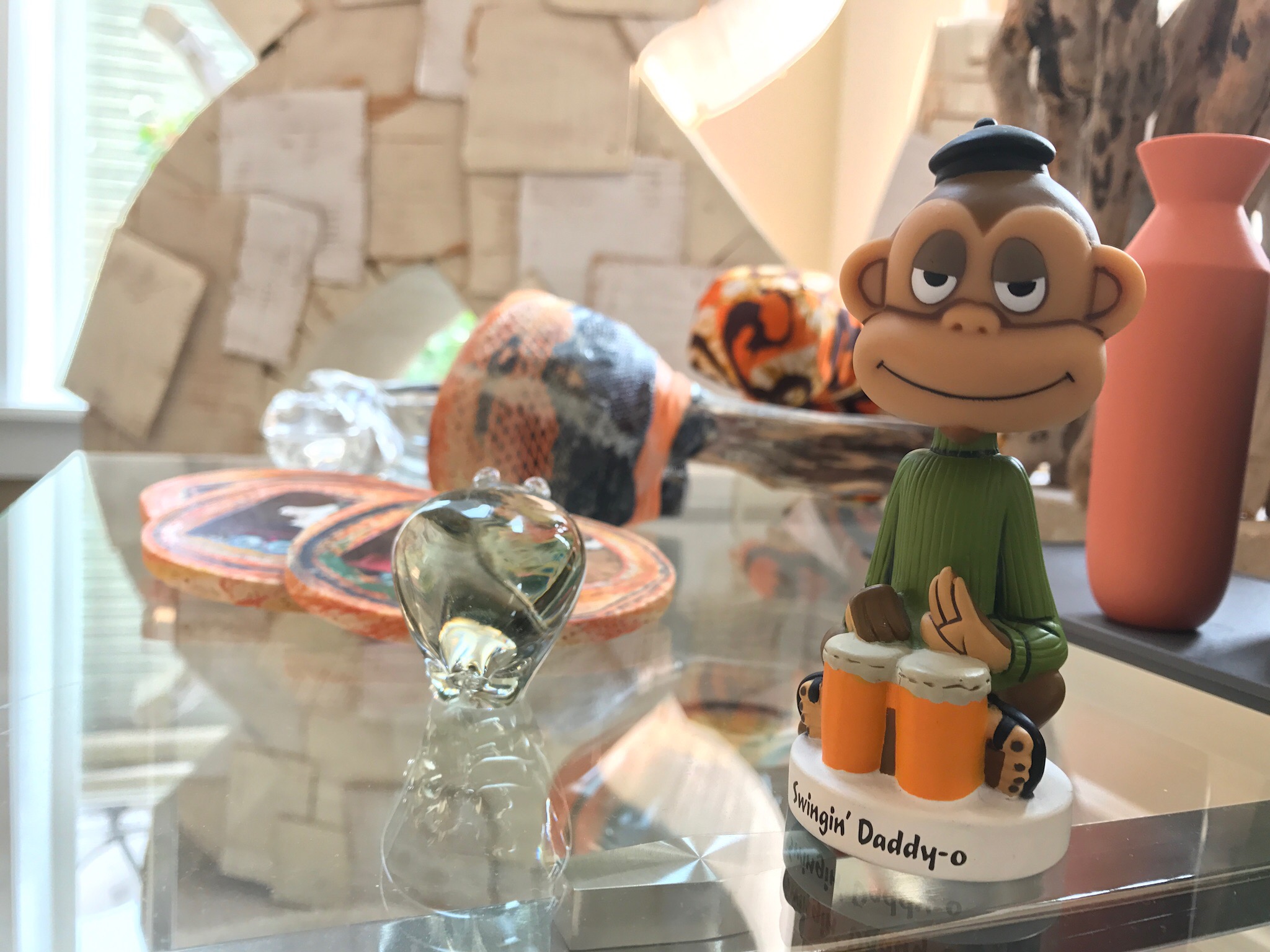
We were working a book together, at his place, and before we started he turned to a monkey bobblehead on his desk and said, “Ready to go?”

“Are you talking to that monkey,” I asked.

“Of course,” he said, “that monkey helps me out.” He wasn’t even embarrassed about it, he said it like I was stupid for asking.

It turns out that everywhere he works he has a different toy, in his case all of them are monkeys, that he talks to before he starts work and then thanks when he’s done. It’s like he has created a magical creativity token for himself. He gives the monkey credit for the ideas, keeps all the money for himself, and when he’s stuck for ideas he pays attention to the monkey for a bit until an idea comes to him.

He uses all monkeys, but he claims that it works with any toy that has a face.

Here are his steps toward creating your own magic object.

1. Find an object with a face. It doesn’t have to be a toy, it could also be a statue or some other sculpture. Just make sure it has eyes you can look into. If you are religious, you can even use a religious statue of some kind. In fact, the more belief you have in it increases its usefulness.

2. Give the object a prominent spot in your workspace. Somewhere you can see it and reach out and grab it is best.

3. When you start working, acknowledge the object in some way. You can touch it, talk to it or just look at it. Just make sure that this become part of the ritual.

4. Although he didn’t do it in front of me, he also talks to his monkey. If you are stuck, ask your object for the answer. I’m not sure how it answers, we didn’t get into that.

5. Last, and most important, thank it when you’re done. Even if you don’t think your version of the monkey has done anything, thank it. According to my friend, this helps relieve the burden of starting the project again. Instead of having to remember where you were, all you have to do is go back to the monkey and pick up where you left off. This completes the cycle and lets you walk away with no weight on your shoulders.

I haven’t tried this tip yet, but my friend tells me it works wonders. In fact, he says a lot of people do it without realizing it. If you look at artist’s and designer’s workspace, you’ll always find at least one fun object with a place of prominence.

If nothing else, this will give you an excuse to go shopping for toys.

Walking backwards into the future: creativity tip

Creativity is often just a matter of trying to figure out what comes next. We try to figure out where the next brush stroke belongs on the canvas or what word goes next in a sentence.

In a sense, we almost cast ourselves as prophets as we work. When our prophecy is wrong, our next steps strike the audience as cheap or shocking. We change the established rules of our creation and take the audience out of its reality. If the next step is solid, the audience relaxes and extends its trust to you.

One way to increase the reliability of your predictions is to look backwards instead of forward. Look at what you have already done and draw your answers from that.

The simplest illustration of this is to think of a mystery novel. If you reveal on the last page that the killer was someone who you hadn’t previously introduced to the reader, your book is going to be thrown across the room. Obviously, the whole basis of a mystery novel is to make the killer someone who has always been there, but the audience didn’t suspect.

The answer is don’t keep making things up. Look to the past to find out what should happen now. Know that new elements introduced late in the game will never hold the same weight for an audience that the initial elements have.

The next time you get stuck while you’re working, stop looking forward, turn around and see what has already happened. Don’t make up something new, use what you already have. It may seem less creative, but it’s much more satisfying.

Enthusiasm – possessed by an idea

IMG_8912

Successful creative people have boundless enthusiasm for their work. It gives them pleasure even if it’s difficult or painful. They are swept away in a trance that causes them to deny any doubts they might have about what they are doing.

The word “enthusiast” originally meant a person possessed by a divine being. In other words, a feeling beyond faith or doubt. Being an enthusiast meant becoming one with the object of your belief.

Do you have enthusiasm for your work?

Put yourself aside while you work and literally become possessed by your idea. You will have no doubt because you aren’t discovering something outside yourself, you are just describing what you have momentarily become.

We’ve all heard about characters who take over stories or pieces of wood that tell a sculptor what shape they contain. These are just descriptions of the momentary possession of enthusiasm.

Use your moments of doubt during revision, but during creation be an enthusiast.

Pay attention! For a minute: creativity tip

Screen Shot 2017-08-20 at 8.13.01 AM.png

The New York Times had an article on a man,Christopher DeLaurenti, who recorded the intermissions of classical music concerts. He’s going to release a CD of them and defends them as interesting collections of sound.  To him they are a kind of avant-garde music.

There’s an interesting quote from him when he explains how he sneaked into concerts with recording equipment and escaped detection:

He honed a technique of often shifting his posture and moving around. “Most people are not observant and rarely look at one thing for longer than 10 seconds,” he said.

I know that isn’t a scientific observation, but it strikes me as about right. Most people don’t look or think about any one thing for more than about 10 seconds. In our modern age, bouncing from page to page on the internet, 10 seconds feels like an eternity.

Her is my challenge to you. Every single day find something that you have never paid attention to before and give it a full minute of your time. There’s a lot you can do during that time. Make a list of distinguishing characteristics. Sketch it. Try and figure out the story behind it. Try and imagine what the design team was thinking when they designed it, if it’s human made, or what purpose it serves, if it’s natural.

Don’t let your attention shift to something else until a whole minute has passed. Break that 10 second barrier and give more attention to the world around you. You can unearth amazing things and notice incredible dramas unfolding all around you.

And, if you’re lucky, you’ll notice a guy with a chest full of recording equipment taping an intermission. Don’t stop him though, he’s making music.

Link to Christopher DeLaurenti’s site with free mp3 of an intermission