A James Lipton of your own

lipton071015_198

I was watching Inside the Actors Studio the other day and it struck me that even though its host, James Lipton, is sycophantic to the extreme, it’s certainly not surprising that people want to do his show. After all, people in the public eye are constantly judged, critiqued and have their work diminished. Instead of feeding already huge egos, don’t you think that some of the actors almost look at doing the show as a vacation from their own inner-critic?

We could all use a break like that. I had a thought. Why not make up your own little James Lipton and let him live in your head? You don’t have to talk to  him all the time, maybe you can imagine him a little one room apartment to wait in until you need him. But, when you need him he’ll be there.

At your darkest moment, call him forth. He’ll appear with his stack of cards and list of adjectives to describe how fabulous you actually are. Fantastic! Amazing! SUPER! In fact, your little James Lipton can’t help but think that you are perhaps the most amazing person he has ever met.

And those cards, such information! He has every single thing that you have ever done that he admires. There are things on those cars that you’ve forgotten or might be slightly embarrassed about, but he’s there to make you forget any nervousness. Remember, in his eyes you are fantastic.

While he’s there, you can ask him about anything you’re working on. He will love it. He will think it’s amazing. You have topped yourself!

Then, when you feel your butt has been suitably kissed and your ego stroked, he’ll ask you a few questions and then go back to his little apartment. (What is your favorite curse word? What turns you on?) Then, refreshed and confident you can go back to the harsh realities of the real world.

Right now, my little James Lipton is sitting in his apartment wearing a bathrobe, eating crackers and watching soap operas. He’s waiting until I need him again.
Theory of Obscurity – creating for yourself

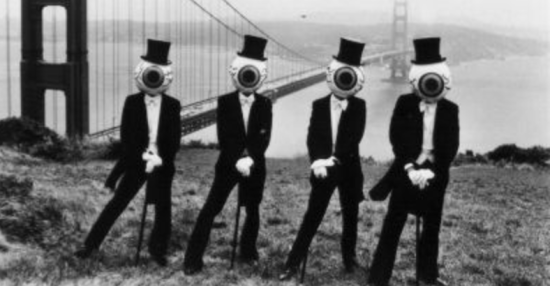
Screen Shot 2017-08-20 at 8.04.49 PMThe Residents may be the world’s most famous unknown band. No one knows who is actually in the band, they disguise their face with giant eyeballs or other disguises, and their music is not designed to appeal to everyone. In fact, it is purposely composed to appeal only to them. They developed their interesting way of looking at the world through the theories of (possibly fictional) Bavarian composer N. Senada. The theory, as stated in this Wired article, goes as follows.

According to this philosophy, artists do their purest work in obscurity, with minimum feedback from any kind of audience. The theory adds that with no audience to consider, artists are free to create work that is true to their own vision.

I bring this to your attention because it led The Residents to try an interesting exercise. They decided for this theory to truly operate, they would have to create music that was not intended to be heard by anyone. They recorded an album that there were going to lock away in a vault until they forgot about it. Eventually, during a dispute with their label, it was released under the name Not Available.

I remember a woman in a poetry class I took years ago. She was so
desperate for an audience and so fearful of a negative reaction that
she would write poems, tear them out of her notebook and abandon them
on park benches and buses. She hoped that someone would find them and
be touched in some way. She would sit in class and cross out negative things in her poems because she was afraid people would like them less.

I was often left wondering what she actually thought because all she wrote was what she thought I wanted to read.

Creating for no audience with the intention of locking something away may be just what you need to spur yourself onwards. If nothing else, forgetting an audience will let you push yourself into areas you might not be comfortable with. It will let you bring up ideas and thoughts that you do not otherwise consider for fear of being judged.

Use the Theory of Obscurity in the spirit in which it is intended. It only matters while you are creating. Afterwards, if someone does see it, it doesn’t compromise the initial process.

Let other people’s failures be your inspiration!

There are really two types of inspiration. One is a work of genius so perfect and complete that it inspires you to set your sights higher – to try to make something as good or better. However, there is another, equally important, kind of inspiration. Genius can be overwhelming and scary. If someone else has reached such heights, how could you ever reach them? If so, the second type is for you.

Have you ever seen a movie or read a book so bad you thought to yourself, I could do better than that. Seeing or experiencing something terrible, a horrible artistic failure, can motivate people to try it themselves.

Not only that, but in bad art the mechanics behind it are visible. Reading a terrible mystery novel reveals every trick a mystery writer uses except done sloppily and obviously. It points out so many dead ends, it becomes a road map for doing it correctly.

The next time you are feeling overwhelmed with insecurity, just find a terrible example of what you want to do. Find a bad movie, book or song that actually got produced and released commercially. Then, read, watch or listen to the entire thing.

Obviously, you can do better than that.

Creativity tip: tell a tall tale

One form of creativity is exaggeration. The ability to take the formless, random occurrences of life and turn them into a satisfying story or image means that you have to focus in on some parts and forget about others. The parts that are focussed on are exaggerated and heightened.

Recently, exaggeration has come under fire. The New Republic attacked David Sedaris for making up parts of his stories and changing details. I hope they also plan on going back and exposing the lies of Mark Twain in his personal essays. And, while they’re at it, they might as well expose the lies of Louis CK, Richard Pryor and every other comedian who tells true stories about their lives.

To deny the value of exaggeration in your creative life is to deny your creative life altogether. As soon as you try to communicate an event you’ve observed to someone else, whether it’s through writing, sculpture, painting or any other method, it is no longer “the truth.”

In my estimation, you should wear your exaggerations proudly. Realize that the people you meet become symbols when they become part of art.  Artists are the most skilled liars in the world. Some are so skilled at it that they have convinced themselves that they never lie.

Lie consciously, lie well and remember your lies so that when you lie again you don’t negate something that you’ve already said.

Overcoming obstacles: mental parkour

Screen Shot 2017-08-20 at 8.55.53 AM

Parkour is the art of overcoming obstacles using only your body with the objective of getting from point A to point B as efficiently as possible. Watching it is almost like watching a dance or circus acrobat’s routine except it’s in the middle of city using found spaces and objects.

Here’s a video of it, skip the first minute or so to get to the good stuff:

What interests me about it is that practitioners report a mental change when they become experienced. Their world ceases to be walls, buildings and fences and becomes an easily navigable landscape. The physical world changes for them because obstacles are no longer obstacles, but tools that they can use to launch themselves. After a while, they start to think that way as well.

Here is a quote from Andreas Kalteis as it appears on Wikipedia :

To understand the philosophy of parkour takes quite a while, because you have to get used to it first. While you still have to try to actually do the movements, you will not feel much about the philosophy. But when you’re able to move in your own way, then you start to see how parkour changes other things in your life; and you approach problems — for example in your job — differently, because you have been trained to overcome obstacles. This sudden realization comes at a different time to different people: some get it very early, some get it very late. You can’t really say ‘it takes two months to realize what parkour is’. So, now, I don’t say ‘I do parkour’, but ‘I live parkour’, because its philosophy has become my life, my way to do everything.

Imagine if all your problems and obstacles were just a playground for you!

We can treat our mental landscape as they treat the world. Sliding, twisting, jumping and ignoring what has been set up before us. Instead of a mental block against something, it becomes a springboard for a backflip. Instead of taking the safe route to a conclusion, what if we just repel down the side of it.

Mental parkour can be a powerful metaphor. I am going to experiment with it for a few days and see if anything happens. Anyone want to join me?

Warm up for being creative

If you are going to exercise, you have to do some stretches to warm up. You don’t just throw your body into high gear immediately.

Why don’t we warm up for being creative?

I think some of the same physical warm ups are useful. Taking a walk or stretching before you start working definitely gets the blood flowing. Treat it like it’s a physical activity and you’ll find yourself more alert and focussed.

Then, there warm ups you can do with your brain. These are more personal. I know people who mentally warm up for the day by doing a crossword puzzle. Other people read a few chapters of a book or doodle on a pad.  I even know  one person who makes up  new nicknames for politicians that make him angry as he listens to the news on the way to work.

I find for me that talking to other people is an important part of starting to communicate. I tend to start the day inside my head and I need something to pull me out.

What warm ups work for you?

Allow yourself a moment of stupidity

stupid face

I know. You are a super genius and I respect that.

However, did you ever notice that a lot of good stories start with a moment of stupidity? A poor choice or easily avoidable mistake is made by the lead character which leads to amazing adventures.

After all, your better judgment is designed to keep you safe and secure. Going against it leads to new experiences. Keep the stakes low, no need to drive 150 MPH on the freeway or try cliff diving. Try going someplace without a map or definite directions or talk to that guy on the bus.

You can sit back and wait to have adventure thrust upon you, or you can chase after it by saying to yourself, “I know that I probably shouldn’t be doing this, but…”

Make trash your treasure: creativity tip

joy buzzer

I’m reading Life of the Party a history of the Adams practical joke and novelty company. You know them, they make all those tiny Joy Buzzers and Whoopie Cushions you find on wire rounders in novelty stores. It turns out that their company was founded on a creative use of industrial waste.

Their founder work for a dye company that paid handsomely to remove the chemical dianisidine from the German coal-tar derivative they sold. He noticed that when people were around the chemical they sneezed uncontrollably. So, he packaged it in a tube (labelled Cachoo sneezing powder) and sold it as a practical joke!

So often, what other people dismiss or throw away is actually a good source of ideas or material. Adams built an empire on a waste product. There could be any number of valuable assets just waiting for you in the nearest garbage can.

One word of caution, despite being labeled “It’s harmless, it only makes you sneeze,” it turned out to be toxic and eventually be banned by the FDA. So, modern sneezing powder is just ground pepper.

The author of Life of the Party, Kirk Demarais, has a great blog with lots of info about the novelty and toy industries.

Adapt a Classical Style: Creativity Tip

Screen Shot 2017-08-06 at 9.28.06 AM

I just visited the Toledo (Ohio) Art Museum and they had a wonderful painting by Kehinde Wiley. Instead of rejecting the past and trying to do something completely new, he has made himself a clear descendant of classical portrait artists.

Looking at his paintings, you can see all the symbols and elements of classics portraits, but they are in slightly different contexts. Sometimes, just putting someone in a classic pose with modern clothes on creates an amazing new piece.

It got me thinking about how much potential there is in completely owning the past and clearly showing the lineage of what you do. When you are trying to create something new, don’t throw everything out. Keep what works and make it better and different.

One more note about Wiley’s paintings, in person, the skill level and craft is tremendous. In the tiny versions on the web some of them appear tossed off. In person, they are huge, amazingly crafted pieces with great detail.

Work at the top of your intelligence: creativity tip

Here’s a rule from improvisational theater that I think applies to everything you do.

Always work at the top of your intelligence.

Don’t talk down to your audience. Don’t feign ignorance or actively ignore what you know. Don’t pretend that you’re saying something deep when you know it’s just repeating a casual observation you heard on NPR. Always use everything you know and every bit of your understanding when you’re working.

Bring your unique perspective to everything you do. Every experience. Every opinion. Everything that makes you who you are.

Also, admit to not knowing things. Sometimes exploring your own gaps in knowledge produces great revelations and interesting work.

Always working at the top of your intelligence is the key to producing things that you are proud of.