Don’t save your best ideas for later: creativity tip

There’s a concept floating around that each person gets only a limited number of ideas in their lifetime.

Maybe no one ever says it out loud, but they treat their own ideas that way.

Instead of using their great ideas as they have them, people squirrel them away and store them on an idea shelf in their heads where they gather dust. And there are only so many ideas you can fit on that shelf, so instead of constantly coming up with new ideas, they just wander over to the dusty mind shelf and look at the great ideas they’ve never used. Afraid that if they use them, there will be a terrible empty spot on the shelf that will never be filled.

But, we know that’s wrong. The truth is that as soon as you use your best idea, you come up with a better idea. Burning through them quickly lets you cycle through ideas at top speed.

Even writing an idea down in a notebook will let you come up with a new idea. It’s amazing what clearing your mind of a little clutter will do.

Do a little mind cleaning and act on all the “great ideas” that are sitting on your dusty idea shelf. I promise you, you’ll have more great ideas than you can use in your lifetime.

And no one lives forever.

That’s probably the best reason for using your best ideas right now!

(you know, death)

Improvise your way to a better, faster first draft

One of the major schools of improvisational acting (improv) developed not as an exercise for actors, but as a tool to help creative writers develop new material and overcome blocks. Improv itself is really the art of trying to present the first draft of a play that’s so good it’s worthy of an audience. It doesn’t always work, quality wise, but with improv you always get something.

Without an audience, you have the ability to go back and perfect your draft until it’s fantastic. Instead of this making writers feel free to do whatever they want in their first draft, many people have difficulty even completing the first draft. It occurred to me that these rules might help writers free themselves up while writing.

Following these simple, basic rules of improv will get you a completed first draft and, over time, improve the quality of your first drafts of both fiction and non-fiction. There are great stories that break all these rules, so they really aren’t rules so much as suggestions. In my opinion, it’s better to break one of these rules in a second draft rather than the first.

1. “Yes, and…”

This is the most basic rule of improv. In fact, this is improv in two simple words. The idea behind these two words is that you always accept what came before and add something new.

In acting, the “yes” part of the phrase means not denying what someone else does or says. In terms of sitting and writing your draft, this means that as soon as something is down on the sheet of paper it is part of the story. There is no going back and switching around details because you got a better idea, it’s down in ink. I think more things were written this way before the word processor, but now it’s always easy to go back and change.

Now, let’s talk about the “and.” This addition to the phrase points to not repeating things over and over again. Each sentence should add something to the story or move it forward. So, you accept everything that has already happened and add something new. Each sentence should expand the world of the story or move it forward.

Taken together, they create an unstoppable force creating a world and telling a story.

2. C.R.O.W.

This is an acronym for the most basic parts of a story that needs to be established fairly quickly for a reader to want to continue with the story. They stand for character, relationship, objective and where. Withholding one of these pieces of information too long results in a twilight zone story where everything is just killing time until a last-minute piece of information changes everything that happened before. You’re much better off giving your reader this information and letting the story follow its natural path. It belongs at the beginning of the story.

Withholding this information will make your audience lose patience with you.

3. Start in the middle of the action.

Try to start with characters that already know one another involved in an action. Starting with a couple leaving a dry cleaner with a stolen wedding dress and tuxedo being chased by the shop owner is far better than starting with two characters who have never met sitting on a bench. Strangers need to introduce themselves and have no emotional connections, which means more work for you and more patience from your readers.

4. Listen

I know, you’re not listening, you’re writing. So, really this one should be “read yourself carefully.” Everything you need to tell your story is right there. Often, people don’t figure out what they’re writing about until later drafts. Reading as you write will allow that process to speed up.

Also, have your characters listen to one another and really respond to what’s said to them.

5. Details

Be as specific as possible in your details. If a character is reading, he isn’t reading a book, he’s reading Bridges of Madison County or Highlights Magazine or a copy of the Constitution. Every detail is important. Training yourself to be as specific as possible in your first draft will charge what you write with meaning.

6. Justify

There are no mistakes, justify what you write. If there is confusion or contradiction explain it. Repeated mistakes are a theme! However nonsensical something is in your story, make it natural and real. Justify justify justify. If it truly doesn’t belong, cut it out in the second draft.

7. Change

Some of the worst improv scenes are when all the actors refuse to let their characters change. Story is change, if nothing changes there is no story. Don’t love your characters so much that it becomes like bad fan fiction where the familiar character run through familiar situations and say familiar things and leave ready for the next adventure with no emotional impact at all.

8. The end is in the beginning

Don’t pull in some outside force, deux ex machina, to end your story. Look at what initiated the story and find the solution there. Walk backward into the future figuring out where to go next by examining what has happened before. If a story starts with someone cleaning a gun, someone will probably be shot in the end. If a story begins with a farm boy who wants to be a hero, it will end with that boy either becoming a hero or not becoming a hero.
Aging and marriage, do they kill creativity?

Two interesting articles on creativity and its relation to age.

The first is a somewhat depressing, unscientific and sexist article that suggests that marriage and age tames genius. A psychologist in New Zealand compared the lives of 280 scientists noting the ages that they made their greatest contribution and comparing it to other biographical details.

He says that most scientists stop making significant contributions within five years of getting married.

My favorite part of this article is the reasoning that he uses for men being motivated to be creative.

Dr Kanazawa suggests “a single psychological mechanism” is responsible for this: the competitive edge among young men to fight for glory and gain the attention of women.

That craving drives the all-important male hormone, testosterone.

Dr Kanazawa theorizes after a man settles down, the testosterone level falls, as does his creative output.

No word on what that means for female creativity or other areas of creativity. Groan. This is so sexist it’s almost painful. Not to mention the obvious fallacy of implying that men’s motivation for going into science is to attract ladies. Following that logic, Mick Jagger must have become a rock star because of his passion for knowledge.

A far better article comes from Smithsonian Magazine
, an interview with David Galenson, which divides creative folks into two groups, Young Geniuses and Old Masters. Young Geniuses tend to be conceptual, while the Old Masters improve with age by applying trial and error. Here’s a key quote from the article.

What’s the difference in how Young Geniuses and Old Masters think?

Conceptual people—the Young Geniuses—emphasize the new idea, and plan their work very carefully. They often say that the execution is perfunctory. Indeed, in today’s world, some of the greatest conceptual artists don’t even execute their own work—they have it made by other people. But the Old Masters are never entirely sure what it is they want done, so they couldn’t possibly have anybody else do it. Cezanne couldn’t have said to somebody, “Go and make a painting for me.”

There is no mention of marriage or testosterone levels in this article.

Links via devilduck and Dose of Creativity

Meaning, Metaphor and Magic

I posted before about making a magic object to help you with your creativity and work, but today I was thinking about all the magic in the objects already around us. Not every object has the same amount of magic, but you know the ones that are meaningful to you. Maybe it’s something an old friend gave you to remember them by or a trophy of a great success in your life or a picture of you with a famous person. You know the kinds of things I’m talking about. Generally they have a low dollar value, but you’d miss them the most if they were gone.

What if these things had real Harry-Potter-Lord -of-the-Rings magic powers? That handkerchief you took from your grandmother’s house the day she died. Would it have healing powers? Would it protect you from demons? Would it make cookies appear whenever you wanted one?

The connection between the magic of these items and their powers is the root of the energy of metaphor that powers everything you create. Their meaning is part of you and examining them is like being able to look at yourself from the outside.

So, find that cigar box of mementos you keep or dust off your nick knack shelf and go through them one by one. Hold them in your hand and ask yourself what spell it would cast if it could? What power does it contain?

This is the raw force of creativity at work, the discovery of connections between seemingly disconnected objects and yourself. You’ll get a better understanding of your needs and wants and emotional underpinnings.

What do you keep? What does it mean?

In fact, why limit it to what you own? Look at other objects in the world and ask what magic powers they would have. A pair of Houdini’s handcuffs or a handwritten page from one of Shakespeare’s plays or a piece of the Berlin wall?  It all has power inside and recognizing it will allow you to control it.

Plus it’s fun. So, even if you get nothing from it, you’ll have a good time. Oh, and they don’t really have magic powers, so don’t get any bright ideas that your grandfather’s walking cane can really make you invisible. It’s just that your grandfather made you feel invisible when you were around him because he was such a powerful man. You can’t walk around naked in public just because you’re holding a cane.

Automatic writing: creativity tip

Autom_2
Automatic writing has an interesting history. The name contains what it is, just sitting down and writing without trying to influence what comes out with ideas about meaning or story or spelling or even being interesting. It seems to have started with spiritualism, as a means of contacting the dead in the afterlife, in the 1800s. The spiritualist movement was really about women trying to have positions of power in a society that limited them.

So, automatic writing served two purposes. One, the person doing the automatic writing could pretend that the writing was coming from somewhere outside themselves. Two, other people would take it more seriously because they thought the women were just a means for the message to be communicated. By removing the idea of authorship from the writing, both the writer and reader were free to judge the writing for what it was rather than prejudging its source.

The next group to use it were the surrealists who also did automatic drawing. They believe it was a channel to the “genius of creativity” in all of us. Also, they were attracted to the strange images and rhythms it produces.

I don’t think automatic writing is a message from another world or the key to your subconscious mind, but it is a useful tool for producing raw material.

Here’s a short guide on how to do it.

Find a comfortable place to sit with a flat surface in front of you. Get a pen or pencil and some blank paper.  Clear your head, go neutral, then begin writing as fast you can.  If you find yourself stopping, just use the last letter of the last sentence you wrote as the first letter of the next sentence and keep going. Don’t stop to correct, alter or  insert a better idea, this is simply a big dumping ground for you to produce raw material that you can use for whatever you want later.

Write as long as you want, you’ll know when it’s over.

I recommend putting it aside for a day before reading it. It can be a revelation or a complete disappointment, it doesn’t matter because you didn’t put any effort into it.

Try it. I promise you’ll be entertained. If you feel better pretending that you are channeling a voice from somewhere else, go ahead. That way you don’t have to take the blame for what happens. If you decide to do that, you can pretend you are channeling the voices of aliens, fairies, half-dog half-men that live in the swamps of West Virginia, David Lee Roth or President Taft. Maybe it will make it better!

After all, like all good games this has no rules.


The power of pointless creativity

“Nonsense and beauty have close connections.”
– EM Forester

Have you noticed that a lot of people who write about creativity also try to justify it with practical uses like problem solving or making money? As if creativity were the intended end product of a controllable series of actions. In fact, there are misguided “rules” for creative meetings in offices to keep them on track. Arts programs are discontinued in schools all the time as a waste of time that won’t help you on standardized tests. Even as we recognize the power and importance of creativity, we negate the actual work of it.

And by work I mean play.

I want to argue for the pointless, the nonsense, the impractical and the absolutely useless. It is only through these that we reach a point where we might, at some point, come up with something beautiful or original or world enhancing. The road to a good idea is littered with thousands of terrible ideas. And by terrible ideas, I mean fun and interesting ideas that aren’t what you need at just that moment.

In fact, we’re taught to hide the “bad” ideas. The impractical ideas. The nonsense. To only give the ideas that we know are winners and practical solutions. These leads to boring people, afraid of change, waiting for someone else to say something stupid so they can laugh at it and feel superior.

Take some time to do something pointless and fun. Express yourself in ways that you aren’t good at. Write a dirty limerick, draw, play a practical joke, write a romantic comedy or, in my case, dance. Have fun failing and you can learn to love nonsense and pointlessness. You can recognize that nonsense is sometimes the only visible part of a greater truth. That pointlessness can sometimes be a signpost to something more important.

But, I’m not going to promise anything except a good time. Play is the hard work of a good idea that seems to come in an instant. Make sure you do something every single day that makes the judgmental authority figure in your head roll his/her eyes and question your sanity. You’ll never be able to prove that any of it had any worth to you, but it won’t matter. Pointlessness is its own reward.

Marketing first: creativity tip!

Have you ever heard of Robert Pollard?

He was the lead singer of a band called Guided By Voices and is one of the most prolific songwriters of all time. Over 2,000 of his songs have been commercially released and he has a backlog that will probably still be trickling out long after he retires from music.

How does he do it? He’s incredibly talented, for one thing, but there are also interesting things he does that we can mimic. I watched a documentary on him and I noticed that instead of starting with a song and then trying to find a place for it, he sometimes works backwards. He is constantly looking for song titles all around him. Interesting intersections of words that out of context could make for a poetic song, album title or band name. Then, he designs album covers with track listings for these imaginary groups. He has boxes of them in his house.

It got me thinking. Wouldn’t that work for anything creative?

Couldn’t you design book covers and movie posters and then make the movie they inspire? Why not write a blurb for the back cover or your own review? In fact, you can design a whole marketing campaign to help you focus and make it more real. What is the name of your gallery show? What would the commercial for it look like? What would you say when David Letterman asked you about it?

I’m betting a lot of musicians spent their high school years designing fliers and album covers for bands that hadn’t written a single song. Actors spend time imagining an acceptance speech for an academy award. Sometimes it’s the unimportant stuff that drives us toward the meat of creativity.

A friend of mine pointed out a cool way to make up your own band and album. (Although with slight modifications, this could give you a book title and chapters.)

Get your band name by using the title of the article you get clicking here.

Then, get the title of your album by taking the last four words of the last quote you get by clicking here.

For your album cover, click here and use the third picture.

And last but not least, write the album. That’s the easy part, right?

(Need more help? For song titles try this song title generator. I got Confused Riot which sounds like a Guided By Voices song title.)

How To Survive Writing (and Yourself)

Grady Klein has posted a wonderful and funny comic with advice on how to survive any creative venture. In his case, it’s a graphic novel, so it’s titled How to Survive Writing a Graphic Novel. Visually, it’s a graceful dance between the artist and his demons. My favorite bit of advice in regard to your demon is, “No matter if he is bugging the **** out of you, always listen to him. Whatever he says.”

6a00d8341d928653ef00e54fbc374e8834-800wi.jpg

Found via Drawn

Stanley Kubrick quotes on creativity

Stanley Kubrick is widely considered to be one of the best filmmakers of all time. From Clockwork Orange and 2001 to Full Metal Jacket, his movies were memorable and unique. Marlon Brando said, “Stanley is unusually perceptive and delicately attuned to
people. He has an adroit intellect and is a creative thinker, not
a repeater, not a fact-gatherer,. he digests what he learns and
brings to a new project an original point of view and a reserved
passion.”

I’ve collected a few quotes on his process and creativity.

Perhaps it sounds ridiculous, but the best thing that young filmmakers should do is to get hold of a camera and some film and make a movie of any kind at all.

I think the big mistake in schools is trying to teach children
anything, and by using fear as the basic motivation. Fear of getting
failing grades, fear of not staying with your class, etc. Interest can
produce learning on a scale compared to fear as a nuclear explosion to
a firecracker.

If you can talk brilliantly about a problem, it can create the consoling illusion that it has been mastered.

Any time you take a chance you better be sure the rewards are worth the risk because they can put you away just as fast for a ten dollar heist as they can for a million dollar job.

I think it was Joyce who observed that accidents are the portals to discovery. Well, that’s certainly true in making films. And perhaps in much the same way, there is an aspect of film-making which can be compared to a sporting contest. You can start with a game plan but depending on where the ball bounces and where the other side happens to be, opportunities and problems arise which can only be effectively dealt with at that very moment.

I think that one of the problems with twentieth-century art is its preoccupation with subjectivity and originality at the expense of everything else. This has been especially true in painting and music. Though initially stimulating, this soon impeded the full development of any particular style, and rewarded uninteresting and sterile originality.

The events and situations that are most meaningful to people are those in which they are actually involved–and I’m convinced that this sense of personal involvement derives in large part from visual perception. I once saw a woman hit by a car, for example, or right after she had been hit, and she way lying in the middle of the road. I knew that at that moment I would have risked my life if necessary to help her…whereas if I had merely read about the accident or heard about it, it could not have meant too much. Of all the creative media I think that film is most nearly able to convey this sense of meaningfulness; to create an emotional involvement and a feeling of participation in the person seeing it.

How could we possibly appreciate the Mona Lisa if Leonardo had written at the bottom of the canvas: ‘The lady is smiling because she is hiding a secret from her lover.’ This would shackle the viewer to reality, and I don’t want this to happen to 2001.

Develop a rivalry: creativity tip

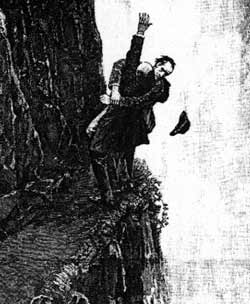
HolmesmorTesla had his Edison, Holmes had his Moriarty and Spielberg has his Lucas. Having a rival or arch-nemesis can really drive your creativity to new heights.

There are two kinds of creative competitions. The first, a rivalry, is the healthier of the two. With a rivalry you find someone whose work you admire and try to top them. Paul McCartney has said that listening to the Beach Boys’ Pet Sounds drove them to create Sgt. Pepper’s which consistently shows up on critic’s lists as the best album of all time. Usually with Pet Sounds at number two. The members of Monty Python talk about how they respected the comedic taste of the other group members so much that it drove them write more and better sketches to top everyone else at table reads.

For this kind of rivalry to work you need to find a living person who is around your age and produces work you admire and aspire to. If it is someone you know, it makes it even better because you’ll have someone whose opinion you respect to bounce your ideas off of. Pick something of theirs that you admire and create something better. Top them. If you can’t, throw it away and try again.

The second type of challenger is an arch-nemesis. This can be more dangerous and more fruitful. It involves picking someone you don’t like who is successful and using them to define yourself. By picking someone who has qualities you don’t like or respect, you are forced to define what you are. Also, watching them succeed will eat on you and drive you try even harder. This is where the danger comes in.

Tesla and Edison hated one another to illogical distraction. Brian Wilson of the Beach Boys hallucinated that Paul McCartney and Phil Spector were out to get him.

One of my favorite recent arch-nemesis confrontations was between Larry the Cable Guy and David Cross. Larry is a “low brow” comedian who has lots of jokes about bodily wast and David Cross is an independent comedian given to long rants about George Bush. Cross made an offhand comment about Larry in Rolling Stone that led Larry to devote a chapter in his book to Cross. Then, Cross wrote an 11 page rebuttal, manifesto, clarification on his website. Not only is this response incredibly funny, it also is a great clarification of what Cross believes and who he is. That is useful information for anyone to have about themselves.

So, if you want to produce smarter, more creative, more vibrant work, consider a rivalry or arch-nemesis. The constant challenge of having to create better work will drive you to new heights!