David Byrne on How and When to Handle Criticism

David Byrne posted in his blog today that one of his friends warned him not to read a review of his current tour in the New York Times. It was less than flattering and was written by someone who had not liked his work in the past. He did not look at it and passed on this wise advice about timing when you take on criticism.

While taking criticism on board can be constructive, it can also be detrimental to the creative process if it’s considered while that process is still under way. It undermines one’s enthusiasm and will — which is OK, beneficial even, but only after a tour (for example) is over. This review, by all reports, wasn’t helpful criticism anyway — it seemed to be one of those reviews that comes from some psychological issues the writer has — and therefore even a belated reading is not going to help us refine what we do.

David Byrne

Creativity is a Conversation

Reading Ken Robinson’s book The Element: How Finding Your Passion Changes Everything. So far, it’s amazing. It’s about finding out what your passion is, how to get good at it and how that will make you happy.

Passion + Talent = Happiness

This quote has stuck in my head for a couple of days because it just seems so right:

“You can think of creativity as a conversation between what we’re trying to figure out and the media we are using.”

I think it should be “figure out or express,” but that’s just nit picking. Lots to think about in that statement.

Seth, Sweatshirts and Creativity

The amazing Seth Godin cast his spotlight on creativity this week. In a short post he does a good job of using a sweatshirt as a metaphor for creativity.

For me, creativity is the stuff you do at the edges. But the edges are different for everyone, and the edges change over time. If you visualize the territory you work in as an old Boston Bruins sweatshirt, realize that over time, it stretches out, it gets looser, the edges move away. Stuff that would have been creative last year isn’t creative at all today, because it’s not near the edges any more.

It’s true, creativity is moving all the time. That’s why if you write an idea down and forget about for a few years, you’ll likely find someone has already done it by the time you get around to it. Seth uses this to persuade you to spend more time near the edge, which I agree with.

However, since creativity is a moving target, doesn’t that mean we should be moving quickly on our ideas? Each creative impulse we have is correct for a moment, but that moment will pass. Don’t spend time on the edge and then not take action. That’s the definition of creative frustration.

Act quickly and often, that’s the way to make progress. If you don’t, you’re just setting yourself up for regret.

We’ve all had to sit next to that guy on the bus that claims he invented Post-It notes in his basement in 1967, but never got around to doing anything about it and now all he has left to do is ride the bus and tell the same story over and over again about what an unrecognized genius he is.

Don’t be that guy. And don’t sit next to that guy if you can help it, his breath smells like tuna fish and socks.

Read Seth’s post here

The ABC’s of Staying Creative

Abc
 Do you experience lulls in your creativity? Do you run hot and cold with ideas? Want to be ready when you need your creativity the most? Here’s one way you can be sure that you are always at the top of your game.

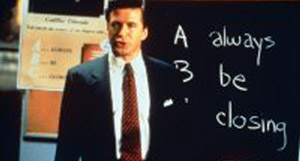
In David Mamet’s Glengarry Glen Ross, Alec Baldwin shows up to deliver a motivational speech to a room full of salesman. Really it’s more threatening than motivational, but one of the bits of simple “wisdom” he shares with them is the ABC’s of sales. The letters stand for “always be closing.” To a room full of people struggling to make a single sale, this advice seems more like a cruel taunt than a guiding philosophy.

What if we changed the C from “closing” to “creating?” Always Be Creating. Is it a taunt to use this as a philosophy of creativity? Let’s take away the idea of failure. We aren’t using the phrase to imply quality, just quantity. So, there really isn’t a way to fail except by not doing anything. It’s not a taunt, it’s a cheer!

Instead of working on something, finishing it and then waiting for the next project, what if you always had multiple projects going on? They shouldn’t all be equally important. In fact, having a few low priority creative projects to work on for fun is completely freeing. What about writing Bacon Haikus? Or doing a drawing a day? Or even wearing a different outfit every day? It doesn’t have to be something you’re good at, in fact, being bad at it might be better in the long run.

These seeming distractions are actually keeping you at your top creative level! Your creativity isn’t a faucet that you can turn on and off, it’s an exploding geyser in the middle of your brain. The problem is that if you don’t go there all the time, you might forget where it is.

Multiple projects. Plans. A giant novel about a war between the ant-people and the walrus-people.  The perfect cupcake recipe. An elf outfit for your bulldog. A list of believable lies about Abraham Lincoln. A list of heavy metal band names that haven’t been used yet. (That last one is harder than you think.) Designing underwear for chickens. Anything you want!

ABC, Always Be Creating! Don’t take a vacation from doing what you love. Keep your projects secret or put them on the web. It doesn’t matter! The whole purpose is to maintain your highest levels of creativity at all times.

It’s as simple as… well.. you know…

Federico Fellini quotes on creativity

Fellini

Federico Fellini directed some of the best films of the 20th century. He was an artist who changed the films that came after him. If you’ve never seen one of his films watch 8 1/2, La Strada or La Dolce Vita and you’ll be amazed at how many movies you’ve seen reference or outright copy him.

When choosing the image to accompany these quotes, I had to hold myself back from choosing an image from one his films. Not that Fellini would have minded, as you will see from the quotes below he didn’t distinguish between life an art. In fact, as he points out, he doesn’t see the difference between reality and imagination as a useful distinction.

Fellini’s films really explore what it means to be a movie. His own life, random occurrences on set, hallucinations and sharp shifts in tone all play into the story. For him, life and creativity were inseparable. Here are a few of his thoughts.

A created thing is never invented and it is never true: it is always and ever itself.

All art is autobiographical. The pearl is the oyster’s autobiography.

Realism is a bad word. In a sense everything is realistic. I see no line between the imaginary and the real.

What is an artist? A provincial who finds himself somewhere between a
physical reality and a metaphysical one…. It’s this in-between that
I’m calling a province, this frontier country between the tangible
world and the intangible one—which is really the realm of the artist.

The artist is the medium between his fantasies and the rest of the world.

You exist only in what you do.

I’m perhaps a special type of spectator. I experience pleasure when I find myself in front of something that is the absolute truth, not because it resembles life, but because it’s true as an image for itself, as a gesture. And therefore vital. It’s the vitality that makes me appreciate and feel that the action succeeded. I think the expression of an artist’s work finds consensus when, whoever enjoys it feels as if they’re receiving a charge of energy, like a growing plant does, of something pulsing, mysterious, vibrant with life.

A good opening and a good ending make for a good film provide they come close together.

Money is everywhere but so is poetry. What we lack are the poets.

I don’t believe in total freedom for the artist. Left on his own, free to do anything he likes, the artist ends up doing nothing at all. If there’s one thing that’s dangerous for an artist, it’s precisely this question of total freedom, waiting for inspiration and the rest of it.

For every creative person, fantasy has certain aspects of obsession. Being unable to free oneself from these fantasies is a kind of torture.

Work is a protective canopy from dark thoughts about the flying time. Creativity creates energy, and energy stimulates the feeling of life.

The Creative Power of Faking It

Today’s post is guest-written by Jay Hathaway an always entertaining writer and blogger! Why do it for real when you can fake it?

——————

Sometimes a fake is even better than the real thing. Before Ben Folds released his latest record, Way to Normal, he spent a day in the studio producing “fake” versions of his new songs to leak to the public. Although these recordings were initially meant as a joke, a fun way to kill a day in the studio, they contain moments of brilliance that match anything on the “real” album. In an interview with Rolling Stone, Folds said that the idea of making a fake album allowed him to create in a way he wasn’t totally used to: “The word ‘fake’ came up when we started doing it and it takes all the responsibility out. You can just be free to write and let it go.”

That goes a long way toward explaining how the leaked album, made in a single day, even came close to the official release. Trying to fake being yourself might actually generate something that feels completely authentic, not burdened by reputation and assumptions. The distinction between real and fake is important during the process of creation, but its power diminishes once the art is out in the wild. If you played Lovesick Diagnostician (a fake song) and Dr. Yang (the real track) for someone who knew nothing about Ben Folds, and asked that person whether they were real songs, the question wouldn’t make any sense.

Frank Portman hit on this idea in one of my favorite novels, King Dork. Tom Henderson, the titular dork, learns the following lesson during his life as a high school outcast: “Start a band. Or go around saying you’re in a band, which is, let’s face it, pretty much the same thing. The quality of your life can only improve.” To really be in a band, you have to make music. When you just say you’re in a band, you don’t necessarily have to make anything.

If you’ve ever made up fantasy band names and album titles, a game Tom Henderson and Sam Hellerman play throughout King Dork, you know that the identity often matters more than the music. The iconography you produce under the guise of your new band can take on a life independent of any music that has been or will ever be made anywhere in the world. There’s something tantalizing about titles of songs and records no one will ever hear and posters for shows nobody will ever play.

Some fake bands, like the ones Tom and Sam create in King Dork, eventually cross over into real band territory. They rehearse, they make recordings, and they play shows. Others have no intention of getting there at all. In fact, they make a point of never engaging in any musical activity whatsoever. My friend Evan Hamilton (who, it’s worth mentioning, is in a real band) told me about The Tree Brains, a “theoretical rock” band that started online (at The Sneeze). Here’s how The Tree Brains describe themselves:

The Tree Brains are an imaginary band that anyone can be a part of. No musical ability is required to join. The band will never play anywhere because it only exists in theory. There is no initiation into the band. If you want to be in it, you’re in it. You may lay claim to any instrument or job in the band you would like.

If you decide to join the Tree Brains, you’ll be able to go around saying you’re a part of the band, and there won’t be anything made up about it.

A concept like the Tree Brains seems fun, but not particularly practical. I think it can actually be put to great artistic use, though. Creating a band, or an alternate personality, takes the pressure off in the same way Ben Folds did when he labeled his work “fake.” If you feel too close to your work, like you’re risking too much, then try acting like it’s someone else’s. Invent a character (or a band) that comes from the part of you that doesn’t self-censor, and then write, draw, build or sing from there, too. The part of Ben Folds that writes whimsical, honest, borderline inappropriate lyrics made a damned good album.
Albert Brooks on creativity, criticism and the internet

Screen Shot 2017-08-01 at 6.00.59 AM

Albert Brooks, the brilliant comedian and filmmaker, participated a Rolling Stone survey of comedians called “What’s So Funny?” One of the topics they were asked to comment on is the impact of the internet on comedy. Brooks’ answer is an amazing commentary on how criticism impacts creativity, especially when you’re developing your talent.

I think the internet is slowly going to take down all creativity. Great art of any kind needs a gestation period. It needs a period where people keep their opinions to their fucking selves. You take any artist from the history of the world, from Michelangelo to Bozo the Clown – and if you can have widespread opinion on their first time out, you can kill the great spark that makes them who they are. That is what the internet is allowing. It’s allowing millions of opinions on Day One. It’s almost like, if you show me your newborn baby, and I do complete genetic testing, and I tell you in the first week of your baby’s life that he’s going to make $18,000 a year and work in Africa and be an explorer, and he’s gonna get bitten by a tiger, and there’s a good chance he’s gonna have leukemia. I’m gonna take the joy out of his early child birthdays. Large amounts of opinion too early in an artist’s life is like a cancer.

Resensitize Yourself

You hear a lot these days about how desensitized we’ve all become from the reality of the world around us. From violence to tragedy to advertising, we’ve managed to build up filters that keep us safe and sane. Let’s be honest, if you let yourself react to every story you see on your local news you’d soon be a quivering mess on the floor – terrified, sobbing and depressed. If you noticed every advertisement you were exposed to, your brain would be filled useless information designed to modify your behavior.

However, have you considered that this desensitizing also works against you while you’re trying to create? That this useful shield for modern living might also be blocking things from coming out? The subtlety of detail, the depth of emotion and raw honesty that art demands are stuck behind the same barrier that you use to not cry when you see a story about a grieving mother on TV.

Why not let yourself the freedom to notice details again? To feel other people’s emotions as if they were happening to you? To actually hear the cars driving by your bedroom window as you fall asleep? To taste food? To feel the socks on your feet right now?

You can always put the shield back up when you need it, but can you take it down when you want to?

You will never lack for ideas and materials if you resensitize yourself. Taking a shower can be of operatic proportions if you feel each drop of warm water hit your skin. Petting a dog and feeling each hair on your hand as the dog relaxes, reassured that its taken care of, is an epic story. This is not exaggeration of the truth, but emphasis on a moment.

How you react to things is how you communicate your perspective on the world. If you cut yourself off from reacting to it, it’s impossible to put anything of meaning back into it.

Songwriting Ideas From Wikipedia – Black Francis Interview

Village Voice Frank Black
Black Francis, lead singer of the Pixies, and incredibly prolific solo artist as Frank Black, gave the Village Voice an interview on his creative process. A lot of it is very specific to songwriting, but I thought this snippet was universally valuable. Beware, if you view your creativity is a fragile flower with magical inspiration from another realm, his method might seem a little mechanical. All I can say is that I have used this exact method before and it works.

Sometimes, you have an idea in your head and it’s just looking for a connection to bring it into the real world. Looking at random things can help it to take shape and connect it to reality more quickly. Plus, you’ll get to surprise yourself.


In the case of Svn Fngrs I had no idea what I was going to write about, but I was really up to the gut to try to go above and beyond the call of duty. And so I was under the gun and I was like, ‘Okay, what the hell am I going to write about here? What am I going to write about?’ And I literally just started doing the random article search function on Wikipedia. And I did this for quite a long time late one evening in a very tired state, and somehow I stumbled upon the article for demigods. And I was like, ‘Oh, demigods.’ And then, of course, ‘Okay, well what is a demigod? And who was a demigod? What do they mean by demigod?’ And, of course, on something like Wikipedia one article has other links in it and suddenly you’re off, you know. So the Internet has become a really great resource for me because I’m not a deep researcher. I just want to have an impression. I just need to find out some facts. I’ve already got my little concept going. My little concept is already in place, but I just need some facts so when I rhyme “phone” with “zone” my couplet – well, hopefully it has some artistic merit on its own, regardless of what it’s about or if it’s about anything – but if it happens to be about something, it’d be nice if it was sort of backing up some cool fact about the subject. It’s satisfying, I think, for the listener and it’s satisfying for me.


Douglas Adams On Creativity and Inspiration

douglasadams
Douglas Adams is one of the great comedic writers of the last 100 years. He wrote for Monty Python and created the enduring Hitchhiker’s Guide To The Galaxy series. He was also a great thinker. I have collected a few quotes of his that relate to creativity. My favorite quote is the one about beliefs: “If you don’t change your beliefs, your life will be like this forever. Is that good news?” An excellent question.

I love deadlines. I like the whooshing sound they make as they fly by.

Having been an English literary graduate, I’ve been trying to avoid the idea of doing art ever since. I think the idea of art kills creativity.

The world is a thing of utter inordinate complexity and richness and strangeness that is absolutely awesome. I mean the idea that such complexity can arise not only out of such simplicity, but probably absolutely out of nothing, is the most fabulous extraordinary idea. And once you get some kind of inkling of how that might have happened, it’s just wonderful. And . . . the opportunity to spend 70 or 80 years of your life in such a universe is time well spent as far as I am concerned.

Writing is easy. You only need to stare at a piece of blank paper until a drop of blood forms on your forehead.

A common mistake that people make when trying to design something completely foolproof is to underestimate the ingenuity of complete fools.

He was a dreamer, a thinker, a speculative philosopher… or, as his wife would have it, an idiot.

It is a rare mind indeed that can render the hitherto non-existent blindingly obvious. The cry ‘I could have thought of that’ is a very popular and misleading one, for the fact is that they didn’t, and a very significant and revealing fact it is too.

Let us think the unthinkable, let us do the undoable. Let us prepare to grapple with the ineffable itself, and see if we may not eff it after all.

See first, think later, then test. But always see first. Otherwise you will only see what you were expecting. Most scientists forget that.

If you don’t change your beliefs, your life will be like this forever. Is that good news?

You live and learn. At any rate, you live.