He was the lead singer of a band called Guided By Voices and is one of the most prolific songwriters of all time. Over 2,000 of his songs have been commercially released and he has a backlog that will probably still be trickling out long after he retires from music.
How does he do it? He’s incredibly talented, for one thing, but there are also interesting things he does that we can mimic. I watched a documentary on him and I noticed that instead of starting with a song and then trying to find a place for it, he sometimes works backwards. He is constantly looking for song titles all around him. Interesting intersections of words that out of context could make for a poetic song, album title or band name. Then, he designs album covers with track listings for these imaginary groups. He has boxes of them in his house.
It got me thinking. Wouldn’t that work for anything creative?
Couldn’t you design book covers and movie posters and then make the movie they inspire? Why not write a blurb for the back cover or your own review? In fact, you can design a whole marketing campaign to help you focus and make it more real. What is the name of your gallery show? What would the commercial for it look like? What would you say when David Letterman asked you about it?
I’m betting a lot of musicians spent their high school years designing fliers and album covers for bands that hadn’t written a single song. Actors spend time imagining an acceptance speech for an academy award. Sometimes it’s the unimportant stuff that drives us toward the meat of creativity.
A friend of mine pointed out a cool way to make up your own band and album. (Although with slight modifications, this could give you a book title and chapters.)
My favorite is “base your success on one project.” It reminds of me of a guy I knew in a creative writing program that had one “professional level” short story and wasn’t going to write another until the first one sold. I had three courses with him and he just kept brining the same story. He rewrote it over and over again.
Another important thing to remember is doing only work that will please your family. This is an impossible task. Your work will be used as a mirror by your family and whatever you produce they’ll compare to their own image and decide what you’re trying to say about them. Good luck with that!
You may have read about it in Vanity Fair. In the early 80s, a group of boys in Southern Mississippi decided they were going to remake Raiders of the Lost Ark shot by shot using a video camera, their friends and whatever props and locations they could scrounge together. It took them seven years to complete. Seven years is a long time to work on something as an adult, but to a 10 and 11-year-old, that’s a lifetime.
I was lucky enough to attend a screening hosted by the director a while ago. The quality of the film is as rough as you would imagine a 20-year-old video tape to be. Despite technical flaws, this movie is a powerful testament to what it means to be a creative nerd. If you have ever wondered why people get obsessed with movies or TV shows to the point of distraction, this movie has the answer. Children from divorced families getting together to create their own fantasy world every summer while people made fun of them.
Technically, the movie has every fault you would imagine. But, those faults pale in comparison to how much they got so very very right. The giant boulder is a giant boulder, the fire in the bar scene is a fire in a bar (admittedly, a bar they built in someone’s cellar) and when Indiana goes under a truck while holding onto his whip and is then dragged behind in the dust, you find yourself cheering in excitement that they pulled it off.
One of the great pleasures of the movie is watching them solve problems that don’t occur to the casual viewer. You wonder how they’ll do the boulder, what the ark will look like and how they’ll pull off the chase scene. The real interest is in the tiny moments. For instance, if you are in a small town in Mississippi, where are you going to get a monkey? When the solution appears on-screen, I found myself laughing not so much because it was funny, but because the solution is so clever.
They just used a Beagle mutt named Snickers.
When Marion is trying to get the monkey off of her shoulder, it’s just a dog trying to figure out why a girl is shaking him around. Snickers rides around on the shoulder of “the Arab” with a look of disinterest and whenever he gets put down, he immediately curls up and goes to sleep. The shot of him on the floor after eating bad dates is just him sleeping in an odd position.
The plane at the end of the first scene is replaced with a boat in a swamp. The natives that chase him there are 11-year-old boys in grass skirts. Time after time they just pull it off in an obvious but tremendously clever way.
In the question and answer after the movie, someone actually had the audacity to point out what scenes and shots were missed. For a split second, I thought the audience, all awestruck at the work and creativity on display, was going to collectively hit him in the back of the head. Chris Stromopolis, the co-director and Indiana Jones, shushed the crowd and started to explain. You see, he said, for the first few years, we could only see the movie at the theater. There were no video stores and it wasn’t on TV. They worked from memory and a Marvel Comic adaptation. It wasn’t until 84 or 85 that they actually could compare what they’d filmed to the actual movie. At one point, they went into the theater with a tape recorder taped to their chests in the hopes of being able to get something, ANYTHING, that they could use. The first time, they were caught. The second time, they got a good tape with dialog.
The most touching moment for me was Chris telling us that scene where Marion kisses Indy in the ship’s cabin is his actual first kiss from a girl and it was captured on film. Which makes me think that what started as an attempt to duplicate an action adventure movie turned, as the years passed, into an elaborate plot to get a kiss from a girl.
In the blooper reel there’s a shot of a kid that they set on fire with gasoline rolling around on the floor asking if they got the shot while someone is standing off to the side trying to quickly read the instructions on a fire extinguisher.
When they tried to make a plaster cast of the kid who played the Nazi Toht’s head for the melting scene at the end. You know, the weird-looking torture Nazi whose face melts, well in this version he’s played by a kid who looks like Ernie from My Three Sons only skinnier and nerdier. Turns out they accidentally used construction plaster instead of plain plaster, so when they put it on his head, it started to heat up to about 107 degrees. They had given him a pad of paper to write on and he wrote the word “hot.” Then, they realized that they hadn’t properly soaped his eyes and they were plastered shut. He reached for the pad again and wrote the word “hospital.” They called an ambulance, but the police got there first. The policeman looked at the plaster coated boy, shook his head and said, “What in the hell are you kids doing?”
One store owner called the police and told them that they were filming child pornography.
Chris is now trying to turn all this attention into a career of some kind. He’s been in LA for 14 years with no luck, but they might be the thing that pushes him over the edge. Their story has been sold and is going to be a movie and a documentary. Hopefully, by the grace of Lucas, this will be released on DVD so every nerd in the world can see it.
In the credits, the movie is dedicated to the memory of Snickers. He was hit by a car before the movie was complete. When an audience member asked about Snickers, Chris almost teared up and said, “Good old Snicks.”
It’s like watching someone’s home movies, but the sheer scope and magnitude of what they pulled off makes me feel like I can do anything. The biggest lesson in all of this is that if they had only half-made the movie, it wouldn’t be that interesting. Remember to finish things no matter what!
Just search for Raiders! The Story of the Greatest Fan Film Ever Made and you can watch it on Netflix.
While browsing through the public domain books in the Google library, I found one called How to Write Moving Picture Plays that was written in 1914 by William Lewis Gordon. It has some good advice (Is your climax strong enough?), some common sense advice (Write only on one side of the paper.), and some advice that is now laughably bad.
Here is the first paragraph of the section called "Kinds of Plays to Avoid."
Avoid any scenes or suggestive complications that may offend good taste or morals. Avoid scenes of murder, suicide, robbery, kidnapping, harrowing deathbeds, horrible accidents, persons being tortured, scenes attending an electrocution or hanging, violent fights showing strangling, shooting, or stabbing, staggering drunkards, depraved or wayward women, rioting strikers, funerals, and all such scenes of a depressing or unpleasant nature. Do not make a hero of a highwayman or escaped convict. Do not reflect upon any religious belief, nationality, or physical deformity. Thousands of men, women, and CHILDREN of all classes, nationalities, and creeds witness these pictures daily. We may occasionally see some play depicted which is contrary to the above advice, but they are the exceptions, and are to be avoided. Give your story a clean, wholesome, pleasant tone, leaving the few morbid tales for others to write. These tales of crime are growing less every day, and consequently the photoplay is growing better.
The Owl Tree started as just a painted tree pasted on a wall, but a great number of the street artists in Seattle have contributed to it now. There are stickers, installations and stencils all placed carefully together to form one piece. Unlike most graffiti that just gets changed by anyone who happens by, this piece was planned and advertised. Its location is secret.
I wish there could be more collaborative art like this. Imagine a gallery where you could add your own painting or modify someone else’s.
Stanley Kubrick is widely considered to be one of the best filmmakers of all time. From Clockwork Orange and 2001 to Full Metal Jacket, his movies were memorable and unique. Marlon Brando said, “Stanley is unusually perceptive and delicately attuned to
people. He has an adroit intellect and is a creative thinker, not
a repeater, not a fact-gatherer,. he digests what he learns and
brings to a new project an original point of view and a reserved
passion.”
I’ve collected a few quotes on his process and creativity.
Perhaps it sounds ridiculous, but the best thing that young filmmakers should do is to get hold of a camera and some film and make a movie of any kind at all.
I think the big mistake in schools is trying to teach children
anything, and by using fear as the basic motivation. Fear of getting
failing grades, fear of not staying with your class, etc. Interest can
produce learning on a scale compared to fear as a nuclear explosion to
a firecracker.
If you can talk brilliantly about a problem, it can create the consoling illusion that it has been mastered.
Any time you take a chance you better be sure the rewards are worth the risk because they can put you away just as fast for a ten dollar heist as they can for a million dollar job.
I think it was Joyce who observed that accidents are the portals to discovery. Well, that’s certainly true in making films. And perhaps in much the same way, there is an aspect of film-making which can be compared to a sporting contest. You can start with a game plan but depending on where the ball bounces and where the other side happens to be, opportunities and problems arise which can only be effectively dealt with at that very moment.
I think that one of the problems with twentieth-century art is its preoccupation with subjectivity and originality at the expense of everything else. This has been especially true in painting and music. Though initially stimulating, this soon impeded the full development of any particular style, and rewarded uninteresting and sterile originality.
The events and situations that are most meaningful to people are those in which they are actually involved–and I’m convinced that this sense of personal involvement derives in large part from visual perception. I once saw a woman hit by a car, for example, or right after she had been hit, and she way lying in the middle of the road. I knew that at that moment I would have risked my life if necessary to help her…whereas if I had merely read about the accident or heard about it, it could not have meant too much. Of all the creative media I think that film is most nearly able to convey this sense of meaningfulness; to create an emotional involvement and a feeling of participation in the person seeing it.
How could we possibly appreciate the Mona Lisa if Leonardo had written at the bottom of the canvas: ‘The lady is smiling because she is hiding a secret from her lover.’ This would shackle the viewer to reality, and I don’t want this to happen to 2001.
I don’t want to review Steve Martin’s new book Born Standing Up, I just want to tell you that it’s a wonderful, concise description of a brilliant comedian’s creative life. It’s warts and all, describing embarrassing mistakes, horrible jobs and exactly where the arrow through the head gag started, in an entertaining, funny way. Although it touches on his personal life, it is really only in relation to his creative life.
One of my favorite sections quotes a postcard he wrote to a girlfriend in 1965. He writes to tell her about tracking down e.e. cummings’s house, e.e. was an early hero, and standing in front of it. This is how the post card ended followed by Martin’s comments on what he wrote.
I have decided that my act is going to go avant-garde. It is the only way to do what I want.
I’m not sure what I meant, but I wanted to use the lingo, and it was seductive to use these pronouncements. Through the years, I have learned that there is no harm in charging oneself up with delusions between moments of valid inspiration.
Also interesting and useful is his realization about giving things a beginning, a middle and an end. He hadn’t realized it at the time, but he had abandoned his stand up career and not looked back. While writing the memoir, he came to this conclusion, “Moving on and not looking back, not living in the past, was a way to trick myself into further creativity.”
An interesting thought, is there something you should give up to trick yourself into more creativity? Are you burned out in a medium?
You should read this book. If the philosophical stuff doesn’t grab you, at least you get to read about the conversation he had with Elvis.
Here’s a collection of Albert Einstein quotes on creativity and imagination. Some merely exalt imagination’s importance, but there is also good advice. My favorite is the idea that the question you ask is more important than the answer.
If at first, the idea is not absurd, then there is no hope for it.
We can’t solve problems by using the same kind of thinking we used when we created them.
The true sign of intelligence is not knowledge but imagination.
Logic will get you from A to B. Imagination will take you everywhere.
The important thing is to not stop questioning. Curiosity has its own reason for existing.
The only thing that interferes with my learning is my education.
Imagination is everything. It is the preview of life’s coming attractions.
I am enough of an artist to draw freely upon my imagination. Imagination is more important than knowledge. Knowledge is limited. Imagination encircles the world.
Anyone who has never made a mistake has never tried anything new.
The most beautiful thing we can experience is the mysterious. It is the source of all true art and all science. He to whom this emotion is a stranger, who can no longer pause to wonder and stand rapt in awe, is as good as dead: his eyes are closed.
The mere formulation of a problem is far more essential than its solution, which may be merely a matter of mathematical or experimental skills. To raise new questions, new possibilities, to regard old problems from a new angle requires creative imagination and marks real advances in science.
One way of describing creativity is finding new connections between previously unconnected thoughts and ideas. Of course describing it this way doesn’t take into account the importance of choosing the ideas you want to connect.
Here’s a cool way to get some inspiration for connections, random pictures.
Here are a few sources for random pictures:
Flickr’s latest photo page: The latest pictures taken by people around the world. (For random pictures from the whole database, click here. They’re displayed like a three panel cartoon.)
Latest live journal pictures: Pictures from public live journal posts as they are uploaded. Click on the picture to see the journal entry it’s from.
People doing stuff: Hit the button and this cool site finds a random proper noun doing a random verb. (Like “Scott whistles” or “Carl begs”.)
Be careful with all these sites, occasionally work inappropriate images will come up.
You can use them in lots of ways, either to pick and choose what you find useful or to run the first two pictures together. Or if you have a problem in mind, just connect it up to pictures until you get a solution.
Plus, it’s really fun to see what other people are up to!
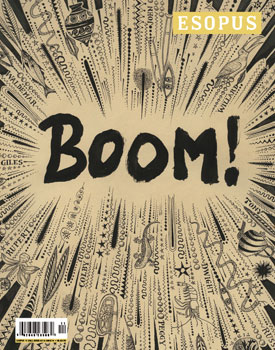
Esopus is more than a magazine, each issue is a work of art. The “articles” in the magazine are actually pages turned over to a different artist to do whatever they like with. From found beauty to pages from sketch journals to movie scripts and photographs, it’s packed full of fantastic stuff. The design of the magazine and presentation is as impressive as the material it contains.
I got latest issue in the mail today and was inspired to write about it because it has a “can’t miss” section. 24 scanned pages from a journal a soldier kept in a German POW camp. 2nd Lieut Gerald Limon drew cartoons, recorded the lyrics of songs written in camp and kept a detailed list of what books he read while he was there. Beautiful, heart wrenching and completely inspirational.
The price for subscribing might seem high ($18) for a magazine that only comes out twice a year, but they actually subsidize with donations and sell it at less than cost because they want to reach a wider audience. It’s non-profit, which means no ads and no one to answer to.
Did I mention that it comes with a CD of music? This month it’s songs inspired by dreams that readers sent in. Did I mention that there are removable pieces and foldouts? This month, there’s a pocket page that holds a reproduction of an old handwriting exercise book that has been subtly modified by an artist.
I love it. This is their site. I give it my complete and unpaid endorsement.


 I don’t want to review Steve Martin’s new book
 Creative Creativity