Listen to the birds: Captain Beefheart and creativity part one

A few years ago, I posted Captain Beefheart’s 10 Commandments of Guitar Playing. You can read that post to see all of them, but this week I wanted to take some time to comment on them a few at a time. HIs list is different than most “how to be creative” lists because it’s a poem, a magic spell and yet it still has very practical advice embedded in it.

Captain Beefheart (Don Van Vliet) was an outsider musician famous for his unique sensibilities, intensity and for doing things like kicking a drummer of out of his band for being unable to follow the instruction to “play a strawberry.” Instead of struggling to be original, he seemed instead to be trying to find a way to make his endless creativity intersect with the rest of the world.

I am giving my imperfect interpretations below. Please leave your take in the comments.

Captain Beefheart’s 10 Commandments of Guitar Playing

1. Listen to the birds

That’s where all the music comes from. Birds know everything about how it should sound and where that sound should come from. And watch hummingbirds. They fly really fast, but a lot of times they aren’t going anywhere.

He’s not saying to mimic the songs of the birds, which you might assume since this list is about music, but to look at their method. Their music is not something they decide to do, it’s part of who they are. Birds don’t sit in front of a piano feeling anxiety about being able to write a top ten hit or a perfect love song. They don’t struggle to come up with something to sing, they know where it comes from so they have to let it out. They don’t make mistakes because it’s not possible for them to sing something that they wouldn’t sing. They just keep going with their endless song.

“Birds know everything” because they have no presuppositions about how their music should sound. There is nothing to know. Our knowing how it should sound or directing it to sound like we want gets in the way. Listen to the bird, don’t critique the bird or try and convince the bird to sing something else.

And, don’t forget the hummingbirds going full speed even when they aren’t going anywhere. They aren’t waiting for inspiration. Their effort is not based on a destination or a goal. While listening to the bird is wonderful, don’t forget to take action.

Constant effort based on your true self is his first commandment.

“Listen to the birds” could be read to mean, figure out who you are and put all your effort into being that thing without pretense or judgment.

2. Your guitar is not really a guitar

Your guitar is a divining rod. Use it to find spirits in the other world and bring them over. A guitar is also a fishing rod. If you’re good, you’ll land a big one.

Never mistake the tools of your art for the art itself. Your word processor is not a word processor. Your paintbrush is not a paintbrush. Your ballet shoes are not ballet shoes. They are tools that take the spirits in the other world and transform them into something in the real world. They are what you use to find the ideas you need.

It’s interesting that Captain Beefheart also uses a magical example and a real-world example for this one. A divining rod, or dowsing rod, was a forked stick that you could use to find water underground using spiritual or pseudo-scientific means. So, both a fishing pole and a dowsing rod are used by a person above a giant hidden space to try and discern what’s underneath.

Is that space the subconscious mind? Other people think so. But, it doesn’t matter what metaphor you use. The important thing is to find the tool you need explore that space to get access to the ideas you need.

David Lynch also talks about ideas as catching fish, but his fishing pole is a camera and a paintbrush. In his book on creativity Lynch extends the fish metaphor, but I think it lines up nicely with what Captain Beefheart is saying. For example, Lynch says, “Ideas are like fish. If you want to catch little fish, you can stay in the shallow water. But if you want to catch the big fish, you’ve got to go deeper. Down deep, the fish are more powerful and more pure.They’re huge and abstract. And they’re very beautiful.”

What is your divining rod? What is your metaphor for the place where the ideas reside?

Click here to read part two!

A Beautiful Constraint

planningnessabc-160518055540-thumbnail-4

What if you could view the limitations on your creative work as inspirations?

I recently read A Beautiful Constraint by Adam Morgan and Mark Barden. They do an excellent job of breaking down some strategies to turn limitations into inspirations.

The most powerful thing in the book for me was the stages you work through when faced with a new constraint.

As first, they thought they had identified three different personality types when it comes to reacting to a new difficulty.

Victim: Someone who lowers their ambition when faced with a constraint.

Neutralizer: Someone who refuses to lower their ambition, but finds a different way to deliver the ambition instead.

Transformer: Someone who finds a way to use the constraint as an opportunity, possibly even increasing their ambition along the way.

But, they soon realized that the people with the Transformer personality type also went through being a Victim and Neutralizer. The other people were getting stuck in an earlier part of the process. So, the question became, how do you move through the stages and get to being a Transformer?

For me, defining the territory so clearly provides a map to move forward. Getting a new constraint makes it easy to be a victim. To limit or completely stop our plans because we’re not going to get to do exactly what we thought we were going to do. But, what if our goal was to turn that limitation into a opportunity to improve the final product?

In the book, they cite a study that showed if you build a playground in the middle of a large open field the children playing in it will cluster in the middle. If you build a fence around the field, they will use the whole space. In an open field, it feels safer to be close to the other kids, while a contained area allows you to roam free.

Is there a place in your life where your stuck at the victim stage? Where there’s something that you’d like to do, but you’ve let some constraint stop you from even trying?

Can you take that constraint and turn it into an opportunity to make the final product more unique and possibly even improved?

Even better, can you impose your own constraint that leads to you to something new?

What if you only had 15 minutes to write a poem? What if you wrote a short story where none of the sentences could have more than 10 words? What if you could only paint with supplies you found at thrift shops? What if you wrote a novel that didn’t use the letter “e”?

Practice that feels like playing

Cory_Doctorow_portrait_by_Jonathan_Worth_2

I like this quote from Cory Doctorow about talent. Talent seems like it just appears out of nowhere fully-formed, but it’s really the result of a lot of hard work.

Talented people enjoyed that hard work while they were doing it so much they did it all the time. They practiced to relax. They practiced in every spare moment. To an outside observer, they were suddenly great at something while everyone else around them was struggling because all the hard work was invisible. There was no complaining or browbeating or self-criticism.

People often use the word “talent” in a dismissive way, “It’s so easy for you. I have to work so hard at it but it comes naturally to you.” Aren’t they really envying the amount of work someone has already put in? Or at least envying the fact that the talented person enjoyed all that hard work.

Imagine if you could adopt an attitude of play for something you wanted to get good at. If you could laugh and shake your head when you failed instead of judging yourself. If instead of dreading starting again, you couldn’t wait for the next game to begin. Think about how much faster you’d improve.

Think about how much fun all that hard work would be.


The Marketing Seminar

Screen Shot 2018-01-04 at 7.50.38 AM

Last year I took Seth Godin’s The Marketing Seminar for 100 days.

That’s right, an online seminar that lasts more than three months. Crazy, right?

I want to recommend that you take it.

If you are involved in any creative endeavor that you intend to show to other people, you should be concerned about marketing. Multiple participants in the seminar said they learned more about marketing during the 100 days than the did getting their MBA. Not only do you get 50 video lessons from one of the most brilliant marketers working today, but you also get access to the amazing community he and his team have created.

In fact, the most important things I learned in the seminar I learned from interacting with other participants. I got to exercise my marketing muscles and learn about businesses that I would otherwise never have access to. I now know more about quilting and improvisational keyboard than I ever expected.

The generosity of the other participants astounded me. It made me a better marketer. I left charged up with the possibilities of new ideas and the energy that comes from a group of people clicking together into a group mind working on solutions to shared problems and new ideas.

There were CEOs, artists, political activists, storytellers, life coaches, lawyers, and financial advisors. There was even a guy that sells underpants for your hands.

My advice is that you join and make a commitment to participate. Learn to face your fears head on and to present your work to other people confidently and appropriately.

I found it to be a life changing experience and I think you will too. 

The latest iteration of it starts posting content on January 8th, but you can join up until the 17th. (Edited: Since I wrote this review, a couple of iterations of TMS have come and gone. Check Seth’s site for the latest details.)

If you want some insider info, click the purple dot on The Marketing Seminar site for a reduced price.

One last Keith Johnstone story: The Final Note

On the final day of our workshop Keith Johnstone was very tired and grumpy.

As the day wore on, his notes after scenes grew terse and pointed. He was especially impatient with people that made the same boring mistakes repeatedly.

I was in the final scene of the day with two other actors. It didn’t go very well. The first person to get notes got a long sigh and a reminder to be more present in the scene and not drift off into their own world. I got the next note, much grumpier that I needed to be in the scene physically not just verbally.

Johnstone then looked at the final improviser. He was an enthusiastic person who had been improvising for about year. He was dressed in stained jeans and a loose, dirty sweatshirt with a giant smile on his face.

Johnstone just looked at him and said in a very angry voice, “And you… You should paint houses. The pay is good and you could wear the same clothes.”

Ouch.

Keith Johnstone Part 3

Screen Shot 2018-01-01 at 8.56.30 AM

Another selection of notes from a Keith Johnstone workshop I took in 2003. You can read the first part here and the second part here. All quotes in this article are from Keith Johnstone, commentary is mine.

If two improvisers are in trouble in a scene. (Trouble in the sense of being in a seemingly inescapable situation.) One of the improvisers should say, “I know just what to do” and then say whatever is in his head no matter how stupid. Audiences will love you for your courage.

This is one of the most important lessons in all of creativity. The phrase, “I know just what to do” is like a magic spell that releases your brain to start to try and make a solution when you are boxed in. Try it the next time you have no idea what to do next. Say the phrase and then follow through on what you say.

Audiences feel the tension of the creator who has painted themselves into a corner and they want you to get out. Even if that solution is, “I pull out magic tennis shoes and use their leaping powers to jump into the next room.”

The audience is on your side. They want you to finish your tightrope walk. In most cases, you aren’t even performing live when you create, so you can go back and edit. I find that the solutions you come up with in impossible situations are some of the best.

I ofen go back and change the earlier part of the story to make the solution less strange.

Every decision you make in a scene defines the circle that scene exists in. You should make choices from within that ever-tighter circle and rarely from outside it. Obvious is good.

Every creative endevor is its own world with its own rules. Once you’ve started it, stick to those rules. Use what is in the world you’ve created to tell the story in that world.

Nothing human beings do is accidental.

Instead of apologizing for an accident or mistake, look for reasons. Why did you do that? Were you sending yourself a message? Does it make more sense? Is there a logical reason you’re not seeing? And emotional reason?

Nothing YOU do is accidental. It’s just that you don’t know why you did it yet.

Click here to read the final part

Keith Johnstone Part 2

screen-shot-2018-01-01-at-8-14-43-am.png

Another selection of notes from a Keith Johnstone workshop I took in 2003. You can read the first part here. All quotes in this article are from Keith Johnstone, commentary is mine.

Anyone trying to do their best is disconnected from everyone else. Trying to do your best makes you less fun to watch and less fun to perform with.

We’ve all received the advice “do your best.’ It’s supposed to release you from your fear of failure by saying that if you do your best work and still fail, no one can fault you for just plain not being good enough. Which is actually not very reassuring if you think about it.

Well, when it comes to creativity, trying to do your best will pull you out of the moment. It will disconnect you from the feedback of an audience and your natural impulses. You’ll be in your head trying to define what your “best” actually is instead of doing what naturally comes next.

It not only makes the work less fun, it makes working with you less fun.

Trying to do your best is an invitation to judgement and anxiety when it comes to creative work.

Scared people think verbally.

There is a lot packed into this simple sentence. Scared people are writing a story in their head. Scared people explain what they’re doing. Scared people review their own creations before anyone else can. Scared people justify the limited nature of what they’re presenting. Scared people feel like they need to repeat their story over and over again because they think you didn’t hear or understand it the first time.

Scared people don’t look around for tools to solve a problem, they’re up in their head talking about it. This is one of the cornerstones of “writer’s block.” Instead of doing something, we start talking about it.

The audience gets great pleasure from the obvious. If you run into a frog with a bible in the forest, he should be on his way to bible class not to go to an amusement park.

Audiences love being invited into what you’re doing. They want to move with you and be delighted by their own participation in your thought process. Even if you’re challenging them, they want what you’re doing to make sense. They want to have rules that they can follow.

If frogs can carry bibles in the world you’re creating, they should be able to go to church. Don’t try to outsmart your audience with surprises when you can be obvious and delight them.

Audiences love to watch people fail and then succeed. If you fail three times, when you finally succeed, the audience will be behind you with loud applause. All audiences want to be there on the night when everything goes wrong. If you can fail well enough and cheerfully enough.

Your audience, which is not everyone in the world, wants you to succeed. They are rooting for you. They admire your honest attempts. They’re with you in your struggles. When you finally achieve what you’re trying for, everyone will want to be there.

Audiences don’t want you to bitter or angry about your failures. They don’t want to watch you blame other people or sit and silently stew about how unfair everything is. They want you to smile, shrug and keep trying.

The process of failing well is actually part of the story of your eventual success. Reacting badly will only delay it or make you a villain when you actually achieve it.

Failing well attracts creativity, and audiences, like a magnet.

Click here to read part 3

Keith Johnstone and obvious creativity

DSCF0055

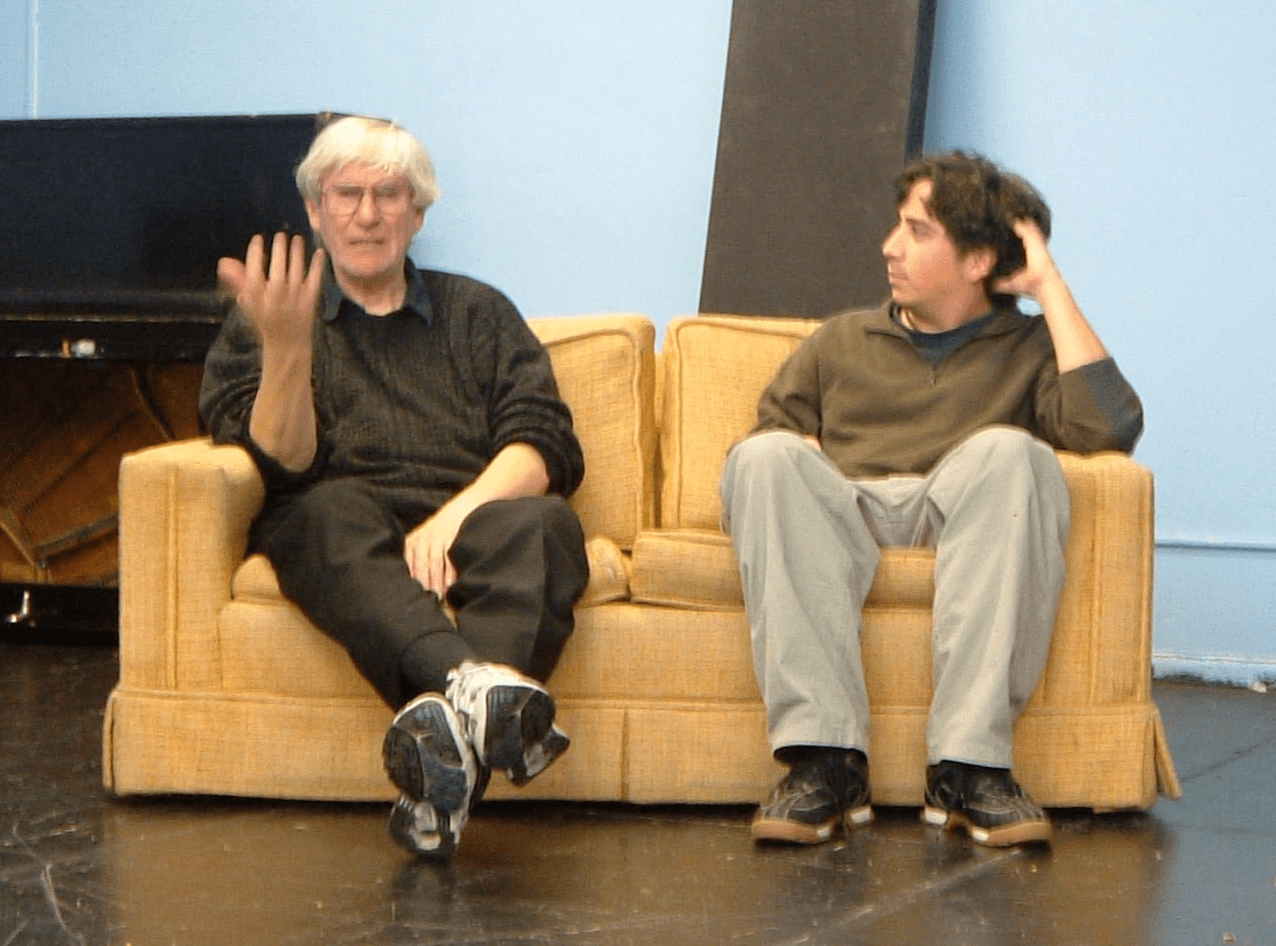
In 2003 I took a two day improv workshop with Keith Johnstone. One of the first things he said to us was, “I have to warn you that this sweater is going on day 5 of being worn by me and I will probably be wearing it again tomorrow. The smell is quite strong.”

He was brilliant, strange, hilarious and grumpy. If you aren’t familiar with his work, he is one of the founding philosophers of improvisational theater and author of the life-changing book Impro. He believes most school and parenting is set up to destroy our natural creative state of being and he developed his methods to help to bring us back to that natural state.

I recently stumbled across my notes and wanted to share the best bits in a series of posts. This first post is just going to be one note, because I think it is so profound.

You should be as obvious as possible. At its heart, your obviousness is unique because it is only obvious to you. In Kafka’s story the Metamorphosis, it is obvious that the character would wake up as a cockroach, because that is how Kafka felt. But, that is not what is obvious to everyone, so it appears creative. You are the only one that thinks you are being obvious.

It seems so simple when you read it, but he’s right.

When we try to be creative, we try to surprise ourselves instead of just being ourselves. Our thoughts and perspectives are unique. What comes naturally to us is surprising to other people.

When you ask most people to be creative, they come up with the same boring things. For example, when I was doing improv and you asked for a suggestion the most common “creative” answer was cheese. When we start to be concerned about what other people think instead of creating something that reflects us, we try to think of something that will appeal to them.

We worry about whether or not people will understand us. We are afraid that if we offer what is obvious to us it will be found lacking. We worry that we are not enough and try to pretend our creative impulses come from outside sources. That muses and voices are whispering in our ear when really it is just the sound of our own voice.

Are you brave enough to be obvious and let that be enough? To let one thought follow the next in a way that makes complete sense only to you? To paint something exactly the way you see it?  To make an inside-joke that no one else might get?

All the best things are obvious to everyone, but they aren’t obvious until someone is brave enough to create them.

Click here to read part 2

Mingus on creativity: making the complicated simple

Screen Shot 2017-08-30 at 6.47.00 AM

Charles Mingus was one of the greatest jazz artists and composers of the 20th century. He was temperamental, opinionated and inarguably a genius. He said about creativity, “Creativity is more than just being different. Anybody can plan weird; that’s easy. What’s hard is to be as simple as Bach. Making the simple, awesomely simple, that’s creativity.”

This quote is a great reminder that just adding more ideas or flourish to a project doesn’t necessarily make it more creative, just different. Breaking something down to its base components and expressing it clearly and concisely is the best way to filter it through yourself.

Let your art be what it is, don’t dress it up with unnecessary bits. Don’t try to hide your flaws with extraneous distractions. When you are at your best, everything that you do carries your stamp, no need to more than that.

In fact, I think Mingus thought that first quote was too complicated, because he simplified it later:

Anyone can make the simple complicated. Creativity is making the complicated simple. – Charles Mingus