How to make a monkey laugh – Why do we laugh?

funny_monkey_smiling-445x360

This NY Times article has some interesting observations about why people find things funny. It also talks about the neurological basis for laughter and how scientists tracked down the primal laugh in rats, their laughter is an ultrasonic chirp, and monkeys.

He and Professor Provine figure that the first primate joke — that is, the first action to produce a laugh without physical contact — was the feigned tickle, the same kind of coo-chi-coo move parents make when they thrust their wiggling fingers at a baby. Professor Panksepp thinks the brain has ancient wiring to produce laughter so that young animals learn to play with one another. The laughter stimulates euphoria circuits in the brain and also reassures the other animals that they’re playing, not fighting.

“Primal laughter evolved as a signaling device to highlight readiness for friendly interaction,” Professor Panksepp says. “Sophisticated social animals such as mammals need an emotionally positive mechanism to help create social brains and to weave organisms effectively into the social fabric.”

Their conclusion is that laughter is a social lubricant and that who and what you laugh at reveals your spot in the social pecking order.

The article also contains an extremely unfunny muffin joke.

Read it here

Lost Art Form – Vaudeville!

vsgrphc3

Vaudeville! The Library of Congress has a great selection of available recordings, films and other information about that lost form of entertainment, the vaudeville stage. You can listen to The Arkansas Traveller, a comedy sketch that dates back to at least 1852! A Laughing Sketch, there were lots of these. It was basically a sketch where something happened and someone with an infectious laugh started laughing until everyone on stage and the whole crowd joined in on the mass hysteria. Or just enjoy a dramatic reading like this one.

They don’t have video collection online, but if you find a title you like in their archive, search youtube, I found Animal Act With Baboon, Dog and Donkey.

There are also scanned scripts available. The featured script right now is The Lone Hand Four Aces (To be acted by a Troupe of Educated Dogs). Most of the scripts read as if they are transcribed from someone describing the stage act to someone else. Which they probably were. Scripts in English and Yiddish.

Perfect for research, inspiration and entertainment.

Learn faster, deeper and better: hacking knowledge

From Online Education Database, not satisfied with those piddly 5 or 10 hint long lists of ways to learn faster and be more creative? Well, this is a list of 77 ways to improve your ability to learn (and just think). They get a bit weak toward the end, but there’s a ton of great stuff here. Health, Kinesthetic, Verbal and Self-Motivation are all covered.

Some tips are obvious, like Use Post-It Notes, or odd, like Learn What You Do Know And What You Don’t, but I suppose a list this long has to have something for everyone.

See all 77 tips here

Scientific Research That Proves Artists See The World Differently

i-a646891cdcd24aaa00b21f54b6f98d04-vart1

From Cognitive Daily an article about how we see the world. They report on a study that tracked the eye movement of two groups, artists and psychologists, as they looked at photographs. The psychologists tended to look only at the object that was the focus of the picture while the artists tended to look at the picture as a whole.

The conclusion:

So why do artists look at pictures — especially non-abstract pictures — differently from non-artists? Vogt and Magnussen argue that it comes down to training: artists have learned to identify the real details of a picture, not just the ones that are immediately most salient to the perceptual system, which is naturally disposed to focusing on objects and faces.

A good article followed by interesting discussion in the comment section.

Read Article

Billy Wilder’s Tips For Writers


Billy Wilder Tips for Writers

Billy Wilder wrote and directed some of the best movies ever made, including Some Like It Hot and The Apartment. In Conversations with Bill WIlder, Cameron Crowe interviews him in great detail about all his films. It’s one of the best books about making movies I’ve ever read.

In the appendix Crowe included Bill Wilder’s 10 tips for writers. I recommend picking up the book for a further discussion of all these points, but there’s a lot of practical wisdom in the list itself.

Billy Wilder’s Tips For Writers

  1. The audience is fickle.
  2. Grab ’em by the throat and never let ’em go.
  3. Develop a clean line of action for your leading character.
  4. Know where you’re going.
  5. The more subtle and elegant  you are in hiding your plot points, the better you are as a writer.
  6. If you have a problem with the third act, the real problem is the first act.
  7. A tip from Lubitsch. Let the audience add up two plus two. They’ll love you forever.
  8. In doing voice-overs, be careful not to describe what the audience already sees.  Add to what they are seeing.
  9. The event that occurs at the second-act curtain triggers the end of the movie.
  10. The third act must build, build, build in tempo and action until the last event, and then-
  11. -that’s it. Don’t hang around.

Link To Book

I’m Switiching My Online Dictionary

I’m lazy when it comes to online dictionaries. I use answers.com because it’s automatically there when you type a word in google. I’m finally switching to wikitionary. Yes, I know that wikis are just user-created, inexact, consensus reality. But, it’s huge, fast and it feels like a living document. Even recently coined words have an entry, usually incomplete, but still something to point you in the right direction.

You can also find curse words in many many languages, slang and debate. Worth checking out.

Wikitionary

Charles Bonnet Syndrome: amusing and magical visions

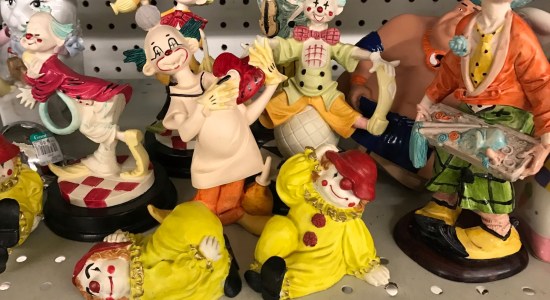
clowns
Here’s an article on an interesting phenomenon experienced by some people while they are going blind. Named for Swiss naturalist Charles Bonnet who observed it in his grandfather in the mid1700s, Charles Bonnet Syndrome or CBS is an affliction that seems to allow its sufferers to pull aside the veil to fairyland and take a peek. Symptoms include seeing hallucinations of all kinds of objects including building, animals and most commonly the floating faces of strangers with features that resemble gargoyles. Here’s a description from the article, “One woman was visited by several tiny chimney sweeps in stovepipe hats that paraded around her home, and another man spoke of a gaggle of monkeys in blue coats and red hats frolicking in his front yard day after day.”

One theory as to why it happens is that as stimuli from the outside world is removed, the brain creates interesting things to fill in the blanks. Here’s a bit from the article that supports that theory:

Formal studies have found that Charles Bonnet Syndrome has a higher rate of occurrence in those with higher education and those with creative leanings, a finding which suggests that the concept-association skills inherent in creativity and intelligence may be playing a role. The whole condition is also reminiscent of phantom limb syndrome, where people with missing limbs experience sensations as though the body parts are still present.

I know that people sitting in zazen meditation also get hallucinations similar to these referred to as makyos. They are often confused as being a vision or enlightenment, but are believed to be simply distractions to meditation.

So, if you are looking for hallucinations, skip drugs and just try lack of stimulation and boredom. You could find your yard full of playing monkeys and that’s always a good thing.

Link To Article

Marketing Yourself: Don’t Push The Bad Stuff

This advice is incredibly obvious, but not easy to hear. One of the primary marketing faults I see in creative communities is that people use all of their resources to push what they produce regardless of the quality of the product. Every actor has been in a bad show. Every artist goes through a period without inspiration. Not all art is created equal. However, some people invite everyone they know to see, read or listen to everything they do.

If people see you produce bad work they are less likely to want to see what you do next. It’s exactly the same process that people use when they judge a company’s products. If you buy a watch that breaks right after you buy it, you are less likely to be willing to buy that brand again. Get bad food from a restaurant and you won’t go back for a while. It’s just basic human nature.

This is particularly important with first impressions. If you read a novel from a writer than you love, you will probably still read their next one. However, if the first book you read by someone is terrible, it’s incredibly unlikely that you’ll ever attempt another novel by that writer.

Since word of mouth is your best advertisement, it’s to your benefit that as few people as possible see the bad stuff. Find honest feedback that you trust and if that feedback tells you you’re involved with a stinker, don’t push it. Make sure people look forward to what you do next.

Even big Hollywood stars don’t follow this rule. Of course, they’re contractually obligated to advertise everything they do no matter how bad. You probably aren’t.

You have limited resources to market your creativity, make sure you use those resources on the good stuff.

Draw Ball Community Art/Graffiti

Screen Shot 2017-08-06 at 10.15.47 AMIt’s a giant virtual ball of art! This site is an attempt at communal art, but it also has the appeal of that wall where all the stoners hang out and draw doodles. You can draw what you want, but know that someone can draw over it.

New users start out with a limited amount of ink. If you create something that the site administrators deem to be of value they’ll preserve it for a while, then add it to the hall of fame and you will win unlimited ink.

There have been several large scale projects undertaken by groups to control the ball. In 2006, a large Korean flag was clearly visible and then slowly was changed into a Pepsi logo by competing artists. Read more about the history here.

It’s worth taking a look at this communal project even if you can’t draw at all. Check out the hall of fame for some really interesting pieces.

Drawball

Exploring Perspectives – 99 Ways to Tell a Story

Screen Shot 2017-07-31 at 8.08.03 AMScreen Shot 2017-07-31 at 8.07.41 AM

Matt Madden has a truly genius book called 99 Ways to Tell a Story: Exercises in Style. He took the same simple one page script and told the story in 99 varying artistic styles. It’s beautifully done and a great reminder about all the choices we make when creating something.


Here’s an interesting look inside the book and how it’s being used.