David Sedaris Inteview

There’s a great interview with David Sedaris in The Missouri Review about his life and how he works. Also, some great discussion on fiction versus nonfiction. One interesting exchange was about the need to wait before your write about something. I think this is one of the big problems with blogs and blog culture. People feel like they need to fill the space in a blog, so they often rush to post about something without letting it percolate.  Here’s what Sedaris had to say:

Interviewer: Do you ever feel you need to wait before you can write about certain events, or about things in your own life?

Sedaris: Definitely. I generally have to wait until I can laugh about something or put it into some kind of perspective. There are stories that I try to write every summer. I turn back to these stories and I wind up thinking, “Nope, not time yet.” There’s this woman named Helen who lived across the hall from us in New York, and I wrote about her for Esquire seven years ago. I worked on it really hard, but it just wasn’t right. It’s not time to write about Helen yet. The first magazine thing I ever did at Esquire was to spend a week at the morgue in Phoenix. I’m not a reporter, and I felt this pressure to flatter the people who worked there. They were very kind to me. Every summer I think, okay, maybe now I can write that story, but it’s not time yet. Sometimes I’ll try to force it. Then other times, wham, all of a sudden I’m able and the time is right. I tried to write about going to the Anne Frank House right after I went, but it took me two years. Was it Flannery O’Connor who said that a writer’s job is not to have an experience but to contemplate experiences? That seems right to me—trying to make sense of it all. Then, too, it’s all about finding the first line.

One of the great things about waiting to write about something is that you get to find out the actual end of a story. Blogs encourage you to record what happens to you, but without the luxury of knowing the impact it will actually have on you. How you are is often not as interesting as what made you that way.

The next time you sit down to write and it’s just not coming, maybe it’s still too soon. Set it aside and try again later. It’s not writer’s block, it’s just not ready yet.

The Missouri Review

More Free Movie and Television Scripts

SteveDaily Script features a different movie or television script every day. I found some scripts here that I haven’t found on other sites and I like the format of a featured script of the day.

The television script section features a lot of pilots. It also has two episodes of the American version of The Office which I found extremely interesting reading. Just from a plotting standpoint, the subtle intertwining of stories is amazing when you dissect it. If you like a script, download it, it might not be there the next time you visit.

Daily Script

Best books for learning to draw

Screen Shot 2017-08-05 at 7.38.14 AM
People often say wistfully that they wish they could draw, as if the ability to draw were some kind of inherited trait that you’re either born with or you’re not. On the contrary, drawing is a skill that you can learn, like learning to read or learning a new language.

Assuming you want to teach yourself to draw, where should you start? Some books on creativity make the mistake of assuming that the reader’s main problem is being creatively blocked or unmotivated. These kinds of books give out advice to do things like make an “artist’s date” with yourself to visit a favorite gallery or treat yourself to new art supplies in order to get inspired.

I think a more common problem for most people is frustration with one’s skill level. If you buy a brand new sketchbook, and you hate the drawings you produce, you’re going to lose the motivation to keep drawing.

So, if you’re looking for a good art instruction book, I suggest finding one that offers concrete advice and drawing exercises, not just encouragement.

Here are the three best books on learning to draw that I’ve come across:

1. Drawing on the Right Side of the Brain by Betty Edwards

This book is considered a classic, and is used in many introductory art classes. Edwards emphasizes drawing what you see, not the symbols for various objects that you learn as a child.

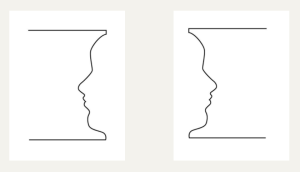
sample exercise: Develop your awareness of negative space by drawing a face vase.

2. Keys to Drawing with Imagination by Bert Dodson

Let’s say you can draw things in front of you; you can draw your friends, a chair, your shoes…

But what if you want to draw something out of your imagination? Dodson’s book shows you how to take your doodles and old sketches and transform them into imaginative scenes. His book emphasizes drawing as a process of transforming things.

sample exercise: Variations on a theme. Redo a drawing several times playing around with the point of view, scale, and framing, or use role reversals. For example, Dodson started out with a sketch of a man being attacked by birds. In one version, he switched the perspective to a giant bird being attacked by miniature flying men. In another version, the man is pursued by bird shaped clouds rather than real birds.

3. Experimental Drawing by Robert Kaupelis

The vast majority of art instruction books assume you want to draw like an old master, but what if you’d rather draw like Matisse or Modigliani?

By providing exercises for learning both traditional and experimental approaches to drawing, this book encourages you to develop your own style of drawing.

Write A Manifesto: Creativity Tip

handturkeySometimes a lack of limitations on your art is stifling. Faced with an infinite number of possibilities, your brain refuses to make any decisions. Define down what you’re doing with a manifesto!

At its most base level, a manifesto is a written declaration of your principles and intentions. However, they can be a blast! Not only do you get to set forth what you believe without justifying it, you can also denounce everything you don’t like! You can use it focus your passion and fill yourself with a sense of purpose.

While you are writing it use the strongest possible language. Take a look at this bit from Manifesto of the Futurist Painters:

We will fight with all our might the fanatical, senseless and snobbish religion of the past, a religion encouraged by the vicious existence of museums. We rebel against that spineless worshipping of old canvases, old statues and old bric-a-brac, against everything which is filthy and worm-ridden and corroded by time. We consider the habitual contempt for everything which is young, new and burning with life to be unjust and even criminal.

We are sickened by the foul laziness of artists, who, ever since the sixteenth century, have endlessly exploited the glories of the ancient Romans.

It doesn’t mean you have to start your own artistic movement, you can use that kind of strong language whether you are knitting, styling hair or tracing your hand on a paper plate to make Thanksgiving turkeys.

Something like:

We violently reject the mass-produced Thanksgiving turkey tchotskies available at Hallmark stores. They exist as stagnant nothings without souls. At a time when thankfulness is supposed to be at the forefront of our very beings, instead we find ourselves faced with a tiny feathered tryptophan drenched disappointments. The answer is the power and cosmic beauty of a hand traced turkey! Is not the hand an avenue into the self? Is not coloring in that hand an expression of all the is good? Making a hand turkey is a celebration of thankfulness that will resound across the universe.

And so on…

Here are a couple more examples:

The Surrealist Manifesto

DADA Manifesto

If you need any help, just comment and I’ll be happy to contribute to your manifesto.

Stephen Jay Gould on Creativity

Screen Shot 2017-08-20 at 3.39.53 PM

From the book Uncommon Genius by Denise Shekerjian, Stephen Jay Gould discusses creativity.

Look, he explained, there is so much nonsense circulating about the creative process. People are all caught up in the Strum and Drang of it, the so-called magic of inspiration, this utterly ridiculous fantasy of a muse:
“Twaddle. Absolute twaddle and one of the worst heritages of Romanticism.”

If I have any insight at all to contribute, he continued, it is this: find out what you’re really good at and stick to it.

Gould elaborated: “Any human being is really good at certain things. The problem is that the things you’re good at come naturally. And since most people are pretty modest and not an arrogant s.o.b. like me, what comes naturally you don’t see as a special skill. It’s just you. It’s what you’ve always done.”

He goes on to talk about how instead of people celebrating what they can do they get jealous and angry about what they can’t do. Don’t waste time trying to do something that you are never going to be able to do well, focus on developing the skills that come naturally.

In other words, find out what you’re really good at and stick to it.

The question that makes you smarter

Have you ever been discussing a problem with someone and hit a dead end? Neither one of you can come up with any possible solution. Then, one of you says, “You know, if we were smart we’d just (insert solution here).”

Notice the phrase “if we were smart”. Now, obviously the solution to the problem came from the person making the statement, but they don’t feel like it did. They feel like it came from outside themselves. Most of the time people stumble on answers like that, but how do you make it happen?

Here’s a question that does wonders. Just ask yourself:

What would I do in this situation if I were smarter?

This question depersonalizes your problems and removes any self-doubt you might have. The answers that come from the question are often shockingly straightforward and obvious. As if you knew the answer the whole time and were just refusing to acknowledge it.

There’s a great visualization exercise for doing this as well. Imagine that inside your head there is a deeply buried bunker with nothing it in but a computer.  This computer contains all the answers and information you need, all you have to do is sit down in front of the computer and type your question in. Seconds later, the response will appear on the screen.

If you prefer, another extension of this exercise is to depersonalize the answer even further and ask, “What would I do in this situation if I was Albert Einstein?” Not that you have to use Einstein, pick someone who you admire and who you are familiar with.

This question gives you access to abilities and resources far beyond what you think you have. In fact, it might prove once and for all that you are smarter than you think you are.

Could it be that you are already a super genius?

Short-term obsession: creativity tip

The word “obsession” has taken on taken on a negative spin in the last decade. It used to be that if you were obsessed with something it meant you were good at it and knew all about it. Well, drug companies and stalking laws have redefined being obsessed, to any degree, as abnormal.

Think about all the great artists in the world that were obsessed with something. Painters that painted the same subjects over and over again. Writers that dealt with the same situations or topics in everything they wrote. It’s funny, but it’s usually because of these obsessions that we enjoy the artist in the first place. It’s like a hook or a doorway into what they do.

To super-charge your creativity, take a topic you are interested in but haven’t studied and developed a short-term obsession. How short? That’s up to you. It could be a day, a week or a month. Read a book on it. Google up all the best websites on the topic. Talk to other people about it. No topic is too high or too low. If you like  Christopher Walken, use him. The possibilities are endless, cowboy poetry, unicorns or squirrel recipes, whatever you find yourself wanting to obsess on, do it!

When you sit down to create you won’t be short on ideas. In fact, the idea will be right in front of you. Make sure you create more than one thing based on your obsession or it really doesn’t qualify.

Eventually, you’ll get tired of your obsession. Just drop it. You can always go back to it. In the meantime, pick something else to be obsessed with.

Being obsessed frees you from having to worry about being “creative” in the sense that most people use the word. You don’t have to come up with a big idea or topic, you just use what is right in front of you.

I’m off to research the use of surgically implanted monkey glands used to keep rich people young in the 1920s.

Find Books and Movies By Plot

Fiction Menu is a site that lets you search for books and movies by plot details. The methodology is very unscientific, so it’s highly unlikely that you’ll be able to find a book you half remember reading as a child. Really, it lets you search other people’s descriptions of recommended books and vote their description up and down. The descriptions vary in quality. Here’s the description for Crime and Punishment:

A poor student kills an old woman, money-lender. But money is not the only stimulus. The murder is grounded on the student’s theory of morality.

Wow. Not much to go on.

Still, it’s a great idea. If the site takes off it could become incredibly useful.

Edit to add:

The original site has been discontinued and replaced with this one!

Process of Design: Do You Have A Final Vision Before You Begin?

256313809_0e8c16d98d

Many Stuff, a graphic design and art blog, asked a group of designers the same two questions:

When you work, do you think in terms of forms or in terms of a creation process? Do you have a clear vision of your final image or does it come only from an upstream creation process?

They answers are interesting, varied and worth reading. They have been published, along with examples of each designers work, in a large (70M) PDF file called About the Process. So, t takes a while to download and some of the answers are in French.

Here is a sample answer:

All I create is just reflexion of me and my feelings. My work is to come up to the mirror and make a copy of the picture I see! Nothing more! – Stanislav Chepurnov

link via PingMag

Download the PDF file here

Find Time To Read

Screen Shot 2017-07-31 at 8.37.55 AM

Having trouble finding time to read? Long stretches of uninterrupted time can be hard to come by. Daily Lit has a great solution. Choose from their selections of about 250 public domain books and they’ll email you an easily digestible chunk. For example, you can get Tale of Two Cities in 170 parts, you choose what days you get the email and at what time. They have ton of classics that you have sworn you’ll get around to reading. Everything from Crime and Punishment to The Autobiography of Benjamin Franklin is yours in bite sized chunks.

I signed up for The Art of Money Getting by PT Barnum in 26 parts.

Link to Daily Lit