Steve Martin’s creative journey

41wY-r2ubCL._SY346_I don’t want to review Steve Martin’s new book Born Standing Up, I just want to tell you that it’s a wonderful, concise description of a brilliant comedian’s creative life. It’s warts and all, describing embarrassing mistakes, horrible jobs and exactly where the arrow through the head gag started, in an entertaining, funny way. Although it touches on his personal life, it is really only in relation to his creative life.

One of my favorite sections quotes a postcard he wrote to a girlfriend in 1965. He writes to tell her about tracking down e.e. cummings’s house, e.e. was an early hero, and standing in front of it. This is how the post card ended followed by Martin’s comments on what he wrote.

I have decided that my act is going to go avant-garde. It is the only way to do what I want.

I’m not sure what I meant, but I wanted to use the lingo, and it was seductive to use these pronouncements. Through the years, I have learned that there is no harm in charging oneself up with delusions between moments of valid inspiration.

Also interesting and useful is his realization about giving things a beginning, a middle and an end. He hadn’t realized it at the time, but he had abandoned his  stand up career and not looked back. While writing the memoir, he came to this conclusion, “Moving on and not looking back, not living in the past, was a way to trick myself into further creativity.”

An interesting thought, is there something you should give up to trick yourself into more creativity? Are you burned out in a medium?

You should read this book. If the philosophical stuff doesn’t grab you, at least you get to read about the conversation he had with Elvis.

“Son, you have an ob-leek sense of humor.”
Develop a rivalry: creativity tip

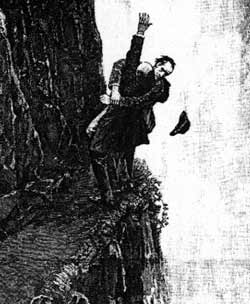
HolmesmorTesla had his Edison, Holmes had his Moriarty and Spielberg has his Lucas. Having a rival or arch-nemesis can really drive your creativity to new heights.

There are two kinds of creative competitions. The first, a rivalry, is the healthier of the two. With a rivalry you find someone whose work you admire and try to top them. Paul McCartney has said that listening to the Beach Boys’ Pet Sounds drove them to create Sgt. Pepper’s which consistently shows up on critic’s lists as the best album of all time. Usually with Pet Sounds at number two. The members of Monty Python talk about how they respected the comedic taste of the other group members so much that it drove them write more and better sketches to top everyone else at table reads.

For this kind of rivalry to work you need to find a living person who is around your age and produces work you admire and aspire to. If it is someone you know, it makes it even better because you’ll have someone whose opinion you respect to bounce your ideas off of. Pick something of theirs that you admire and create something better. Top them. If you can’t, throw it away and try again.

The second type of challenger is an arch-nemesis. This can be more dangerous and more fruitful. It involves picking someone you don’t like who is successful and using them to define yourself. By picking someone who has qualities you don’t like or respect, you are forced to define what you are. Also, watching them succeed will eat on you and drive you try even harder. This is where the danger comes in.

Tesla and Edison hated one another to illogical distraction. Brian Wilson of the Beach Boys hallucinated that Paul McCartney and Phil Spector were out to get him.

One of my favorite recent arch-nemesis confrontations was between Larry the Cable Guy and David Cross. Larry is a “low brow” comedian who has lots of jokes about bodily wast and David Cross is an independent comedian given to long rants about George Bush. Cross made an offhand comment about Larry in Rolling Stone that led Larry to devote a chapter in his book to Cross. Then, Cross wrote an 11 page rebuttal, manifesto, clarification on his website. Not only is this response incredibly funny, it also is a great clarification of what Cross believes and who he is. That is useful information for anyone to have about themselves.

So, if you want to produce smarter, more creative, more vibrant work, consider a rivalry or arch-nemesis. The constant challenge of having to create better work will drive you to new heights!

Inattentional blindness – see the gorilla!

p172qjb053nak1akh1bdd1hl9jgn0_20249

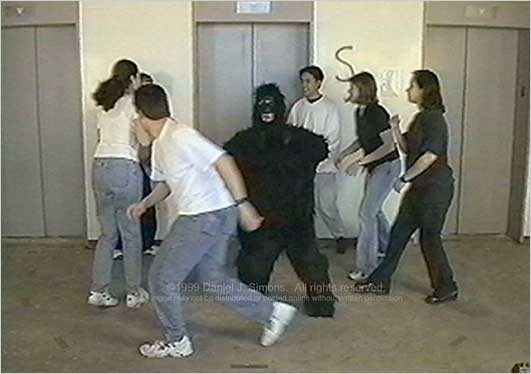
Inattentional Blindness got a lot of media attention last year. It’s the idea that if we lack an internal frame of reference for something it is more than just confusing, our brain actually refuses to even see it. In other words, if you aren’t expecting to see something, you literally won’t see it even if it’s right in front of you.

In the original experiment, people were shown a video of people passing a basketball back and forth and told to count the number of passes. In the middle of the video, a person in a gorilla costume stepped to the middle of the screen faced the camera and then left. After watching the video, the participants were asked if they saw anything unusual and 50%(!!!) of the people did not report the gorilla!

Think about that, half the people didn’t notice a person in a gorilla suit. Everyone I’ve talked to about this says that, of course, they would have seen the gorilla. But, aren’t there obvious things we all miss all the time?

Sometimes, an idea or solution is standing right in front of you, but no one is seeing it. What if you, when faced with a problem, train yourself to look for the gorilla.

If everyone is focussed on the top of a problem, look at the bottom. Look for the gorilla! In fact, if everyone could see the gorilla, you wouldn’t need to be there.

If you know there’s a gorilla wandering around and you can’t see it, call someone else in to look for it. Remember half the people couldn’t see it in the experiment, finding someone with a different perspective might make it more visible.

Isn’t a new idea just a gorilla that no one has seen before?

Einstein On Creativity

Einstein_laughing

Here’s a collection of  Albert Einstein quotes on creativity and imagination. Some merely exalt imagination’s importance, but there is also good advice. My favorite is the idea that the question you ask is more important than the answer.


If at first, the idea is not absurd, then there is no hope for it.

We can’t solve problems by using the same kind of thinking we used when we created them.

The true sign of intelligence is not knowledge but imagination.

Logic will get you from A to B. Imagination will take you everywhere.

The important thing is to not stop questioning. Curiosity has its own reason for existing.

The only thing that interferes with my learning is my education.

Imagination is everything. It is the preview of life’s coming attractions.

I am enough of an artist to draw freely upon my imagination. Imagination is more important than knowledge. Knowledge is limited. Imagination encircles the world.

Anyone who has never made a mistake has never tried anything new.

The most beautiful thing we can experience is the mysterious. It is the source of all true art and all science. He to whom this emotion is a stranger, who can no longer pause to wonder and stand rapt in awe, is as good as dead: his eyes are closed.

The mere formulation of a problem is far more essential than its solution, which may be merely a matter of mathematical or experimental skills. To raise new questions, new possibilities, to regard old problems from a new angle requires creative imagination and marks real advances in science.

Photo inspiration

One way of describing creativity is finding new connections between previously unconnected thoughts and ideas. Of course describing it this way doesn’t take into account the importance of choosing the ideas you want to connect.

Here’s a cool way to get some inspiration for connections, random pictures.

Here are a few sources for random pictures:

Flickr’s latest photo page
: The latest pictures taken by people around the world. (For random pictures from the whole database, click here. They’re displayed like a three panel cartoon.)

Latest live journal pictures
: Pictures from public live journal posts as they are uploaded. Click on the picture to see the journal entry it’s from.

People doing stuff
: Hit the button and  this cool site finds a random proper noun doing a random verb. (Like “Scott whistles” or “Carl begs”.)

Be careful with all these sites, occasionally work inappropriate images will come up.

You can use them in lots of ways, either to pick and choose what you find useful or to run the first two pictures together. Or if you have a problem in mind, just connect it up to pictures until you get a solution.

Plus, it’s really fun to see what other people are up to!

Vaudeville Slang

Here’s a great list of vaudeville slang I found. I love a peek into the vocabulary of any specific art form. A lot of these terms are in common usage now, but some are just a great look into the life of a working performer.

Here are a few:

Three-sheeting
– Hanging around the theatre making it known that you are a performer in order to try and impress others. Grandstanding. Named after the 44″ x 84″ posters that were used in the lobby of the Vaudeville theatre to promote the show

Playing to the haircuts
– Last on the bill. In other words, playing to the backs of the audience as they left the theatre.

The Gerry Society
– The Society for the Prevention of Cruelty to Children. Named for founder Elbridge T. Gerry. Originally founded to prevent the exploitation of child labour, the society was a thorn in the side of vaudevillians. The society declared performers must be over 16 to work in vaudeville. Buster Keaton, Fred Astaire, Rose Marie and Milton Berle were only a few of the child performers who ran into trouble with the Gerry Society.

Also, I had hear the term “working blue” before, but I never knew where it came from…

Blue – Crude jokes or other material using graphic sexual or toilet references or profanity. The term comes from the days when Keith-Albee insisted that performers stick to strict standards of propriety and would send blue envelopes with cuts to performers. You obeyed them or quit. And if you quit, you got a black mark against your name in the head office and you didn’t work on the circuit anymore.

Take the time to learn the slang used by people in the same artistic field you want to be in. It makes it easier to talk to other people interested in the same thing and helps you be taken seriously.

My Favorite Magazine: Esopus

COVER_11_Large (1)

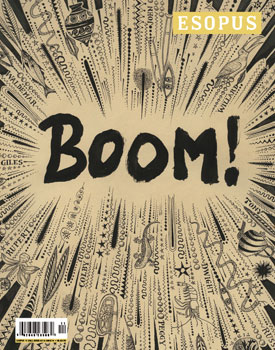
Esopus is more than a magazine, each issue is a work of art. The “articles” in the magazine are actually pages turned over to a different artist to do whatever they like with. From found beauty to pages from sketch journals to movie scripts and photographs, it’s packed full of fantastic stuff. The design of the magazine and presentation is as impressive as the material it contains.

I got latest issue in the mail today and was inspired to write about it because it has a “can’t miss” section. 24 scanned pages from a journal a soldier kept in a German POW camp. 2nd Lieut Gerald Limon drew cartoons, recorded the lyrics of songs written in camp and kept a detailed list of what books he read while he was there. Beautiful, heart wrenching and  completely inspirational.

The price for subscribing might seem high ($18) for a magazine that only comes out twice a year, but they actually subsidize with donations and sell it at less than cost because they want to reach a wider audience. It’s non-profit, which means no ads and no one to answer to.

Did I mention that it comes with a CD of music? This month it’s songs inspired by dreams that readers sent in. Did I mention that there are removable pieces and foldouts? This month, there’s a pocket page that holds a reproduction of an old handwriting exercise book that has been subtly modified by an artist.

I love it. This is their site. I give it my complete and unpaid endorsement.

Bill Watterson on Creativity and Recharging Your Brain.

Bill Watterson, creator of Calvin and Hobbes, gave a commencement address at Kenyon College in 1990. He made some interesting comments on creativity and the creative life. I thought the most interesting section was his comment on how to recharge your brain.

It’s surprising how hard we’ll work when the work is done just for ourselves. And with all due respect to John Stuart Mill, maybe utilitarianism is overrated. If I’ve learned one thing from being a cartoonist, it’s how important playing is to creativity and happiness. My job is essentially to come up with 365 ideas a year.

If you ever want to find out just how uninteresting you really are, get a job where the quality and frequency of your thoughts determine your livelihood. I’ve found that the only way I can keep writing every day, year after year, is to let my mind wander into new territories. To do that, I’ve had to cultivate a kind of mental playfulness.

We’re not really taught how to recreate constructively. We need to do more than find diversions; we need to restore and expand ourselves. Our idea of relaxing is all too often to plop down in front of the television set and let its pandering idiocy liquefy our brains. Shutting off the thought process is not rejuvenating; the mind is like a car battery-it recharges by running.

Creativity as commodity

Money Magazine recently featured an interesting article on creativity. The author suggests that since American can no longer compete when it comes to manufacturing the least expensively produced products in the world, we should change our focus to creativity and innovation.

He points to Google as an example. After all, Google produces so many products, so quickly, it’s impossible to keep up with them. Don’t all the best companies have legions of fans waiting to see what they do next?

I agree with him. Gone are the days when one good idea is enough to build and maintain a fortune or a company can exist that sells a single product unchanged for decades and remain a market leader. Shouldn’t the question always be, “What’s next?”

What he implies, but doesn’t say, in the article is that most companies don’t just not value creativity, they despise it. They focus all their energies on solving momentary problems (putting out fires), refining their hierarchical structure and worrying about why customers aren’t as interested as they used to be. Not to mention that they have to be tricked into learning about creativity by consulting companies who call it “management techniques.”

Creativity is change. Change is scary. Change is something businesses only want when they are in deep trouble.

That said, the business I work for premiered the Electronic Yodelling Pickle today, which Nerd Approved declared to be “The Product Of The Century.”

Google should be very afraid.