Mark Twain Quote On Work and Play

Here’s a great Mark Twain quote about finding out what your "work" is and the dangers of doing someone else’s "work."

What work I have done I have done because it has been play. If it had been work I shouldn’t have done it. Who was it who said, "Blessed is the man who has found his work"? Whoever it was he had the right idea in his mind. Mark you, he says his work–not somebody else’s work. The work that is really a man’s own work is play and not work at all. Cursed is the man who has found some other man’s work and cannot lose it. When we talk about the great workers of the world we really mean the great players of the world. The fellows who groan and sweat under the weary load of toil that they bear never can hope to do anything great. How can they when their souls are in a ferment of revolt against the employment of their hands and brains? The product of slavery, intellectual or physical, can never be great.
Murakami Quote On Creativity

From After Dark by Haruki Murakami. It’s a strange little novel that consists mostly of conversations at night. The first line is from a 19-year-old girl talking to a jazz musician:

“What do you mean, ‘playing really creatively’? Can you give me a concrete example?”

“Hmm, let’s see… You send the music deep enough into your heart so that it makes your body undergo a kind of physical shift, and simultaneously the listener’s body also undergoes the same kind of physical shift. It’s giving birth to that kind of shared state. Probably.”

Be inconsistent today

Screen Shot 2017-08-20 at 8.23.22 AM.png

Today, try and do something inconsistent with your regularly established behaviors. It can be as small as choosing a different brand of soda than you usually drink. Or, as big as endorsing a political candidate from an opposing political party. Do it front of someone who will notice.

People get frozen into their reality because they are afraid to appear inconsistent even when their consistency hurts them. They would rather suffer than to have other people see them change their mind or challenge their own image of themselves. Don’t be so attached to the status quo that your world never grows. How many decisions have you made that limit your world instead of allowing you to experience more of it?

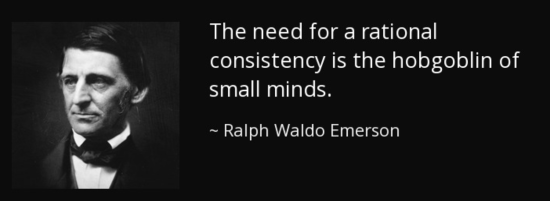
If called upon to explain yourself, quote Emerson. Because then you appear smart and inconsistent. A great combination.

A foolish consistency is the hobgoblin of little minds, adored by little statesmen and philosophers and divines. With consistency a great soul has simply nothing to do. He may as well concern himself with his shadow on the wall. Speak what you think now in hard words and to-morrow speak what to-morrow thinks in hard words again, though it contradict every thing you said to-day.–“Ah, so you shall be sure to be misunderstood.”–Is it so bad then to be misunderstood? Pythagoras was misunderstood, and Socrates, and Jesus, and Luther, and Copernicus, and Galileo, and Newton, and every pure and wise spirit that ever took flesh. To be great is to be misunderstood. . . .

Salvador Dali On Creativity

Screen Shot 2017-08-18 at 4.35.00 PMI just read a great article in The Guardian on the films of Salvador Dali written by JG Ballard. He has some interesting things to say about surrealism, its initial dismissal and current acceptance:

Suddenly, surrealism is everywhere, in those citadels of respectability such as the Tate, the V&A and the Hayward Gallery. Put on a surrealism show and the crowds flock, quietly absorbing these strange and irrational images. It’s as if people realise that reason and rationality no longer provide an adequate explanation for the world we live in. The lights may still be on, but a new Dark Age is drawing us towards its shadows, and we turn to the surrealists as our best guides to the underworld.

I like the idea of art as an instruction manual on how to live in the future. Great article with lots to think about.

I also thought I would also give a few Dali quotes on creativity not from this article:

When the creations of a genius collide with the mind of a layman, and produce an empty sound, there is little doubt as to which is at fault.

You have to systematically create confusion, it sets creativity free. Everything that is contradictory creates life.

One day it will have to be officially admitted that what we have christened reality is an even greater illusion than the world of dreams.

You know the worst thing is freedom. Freedom of any kind is the worst for creativity.

David Lynch On His Creative Process

DL_400x400

David Lynch commenting on how his ideas come together. I have experienced the same process with a central idea serving as a magnet for all the other ideas:

Sometimes if I listen to music, the ideas really flow. It’s like the music changes into something else, and I see the scenes unfolding. Or I might just be sitting quietly in a chair and bing! – an idea will hit me. At other times, I might be walking down the street when I see something that’s meaningful and inspires another scene. On anything that you start, fragments of ideas run together and hook themselves up like a train. Those first fragments become a magnet for everything else you need. You may remember something from the past that’s perfect, or you may discover a brand new thing. Eventually, you get little sequences going. Before you think of anything, the whole landscape is open. But once you start falling in love with certain ideas, the road you’re on becomes very narrow. If you concentrate, ideas will come to that narrow road and finish it.

David Sedaris Inteview

There’s a great interview with David Sedaris in The Missouri Review about his life and how he works. Also, some great discussion on fiction versus nonfiction. One interesting exchange was about the need to wait before your write about something. I think this is one of the big problems with blogs and blog culture. People feel like they need to fill the space in a blog, so they often rush to post about something without letting it percolate.  Here’s what Sedaris had to say:

Interviewer: Do you ever feel you need to wait before you can write about certain events, or about things in your own life?

Sedaris: Definitely. I generally have to wait until I can laugh about something or put it into some kind of perspective. There are stories that I try to write every summer. I turn back to these stories and I wind up thinking, “Nope, not time yet.” There’s this woman named Helen who lived across the hall from us in New York, and I wrote about her for Esquire seven years ago. I worked on it really hard, but it just wasn’t right. It’s not time to write about Helen yet. The first magazine thing I ever did at Esquire was to spend a week at the morgue in Phoenix. I’m not a reporter, and I felt this pressure to flatter the people who worked there. They were very kind to me. Every summer I think, okay, maybe now I can write that story, but it’s not time yet. Sometimes I’ll try to force it. Then other times, wham, all of a sudden I’m able and the time is right. I tried to write about going to the Anne Frank House right after I went, but it took me two years. Was it Flannery O’Connor who said that a writer’s job is not to have an experience but to contemplate experiences? That seems right to me—trying to make sense of it all. Then, too, it’s all about finding the first line.

One of the great things about waiting to write about something is that you get to find out the actual end of a story. Blogs encourage you to record what happens to you, but without the luxury of knowing the impact it will actually have on you. How you are is often not as interesting as what made you that way.

The next time you sit down to write and it’s just not coming, maybe it’s still too soon. Set it aside and try again later. It’s not writer’s block, it’s just not ready yet.

The Missouri Review

Stephen Jay Gould on Creativity

Screen Shot 2017-08-20 at 3.39.53 PM

From the book Uncommon Genius by Denise Shekerjian, Stephen Jay Gould discusses creativity.

Look, he explained, there is so much nonsense circulating about the creative process. People are all caught up in the Strum and Drang of it, the so-called magic of inspiration, this utterly ridiculous fantasy of a muse:
“Twaddle. Absolute twaddle and one of the worst heritages of Romanticism.”

If I have any insight at all to contribute, he continued, it is this: find out what you’re really good at and stick to it.

Gould elaborated: “Any human being is really good at certain things. The problem is that the things you’re good at come naturally. And since most people are pretty modest and not an arrogant s.o.b. like me, what comes naturally you don’t see as a special skill. It’s just you. It’s what you’ve always done.”

He goes on to talk about how instead of people celebrating what they can do they get jealous and angry about what they can’t do. Don’t waste time trying to do something that you are never going to be able to do well, focus on developing the skills that come naturally.

In other words, find out what you’re really good at and stick to it.

Tom Waits on songwriting

MI0003653608

The latest Mojo Magazine has an interview with Tom Waits about his songwriting process. I wanted to share a few quotes. The first is on the diversity of influences songwriters have. The basic point being that you draw from sources that are unlike your own.

We all have a feeling that songwriters are purist, that if you like folk music you only listen to folk music, but it’s not true. Like for example, Howlin’ Wolf loved Jimmie Rodgers and Muddy Waters loved Gene Autry. He didn’t sit around listening to blues all day. It’s like breathing your own oxygen. You’ve got to find some nutrients somewhere.

I love the thought of Muddy Waters sitting around listening to a Gene Autry album and digging it. Creators need a broad range of  sources to create new things. Limiting your consumption also limits your output. If you want to break new ground, you’re going to need every resource you can get.

He also compares hearing new and different music to “entering another world.”

I think everybody’s looking for something they’ve never seen before. You work on your songs, but your songs also work on you. So you absorb and you excrete and in some way you retain, and slowly you start to become some place that songs are passing through. I’d like to think that they enjoy blowing through you. There’s something electric about you, maybe, some kind of a force left behind by music that passes through you. Like everybody likes to be around someone who does something well and loves doing it, so songs would be no different, right? Like, ‘Let’s blow down and see that guy.

In other words, instead of trying to build the songs, make yourself into a person that attracts songs. You have to open all the windows in your house for a breeze to come through and you’ll have to open your mind to new resources for ideas to wander in.

My iPod Is Smarter Than Your iPod

The internet is just loaded with ways to fill your iPod with smart stuff for free!

The best site for free audio smart stuff is LibriVox. This is a sister project to Project Gutenberg their mission is to supply mp3s of people reading books, articles and stories in the public domain. I have found the quality of the readers to be uneven, but I can’t complain because it’s all free.

What about free old time radio shows? Try Old Time Radio Fans. You can even get the original broadcast of War of the Worlds for free.

Even though it is incomplete, if you want some free Shakespeare audio students at Los Medanos college have a podcast where they are working their way through all of Shakespeare’s work. What they have done already is available on their site. Shakespearecast.

Finally, Stanford University offers free audio of faculty lectures on many different topics. This is an amazing service. They have three courses that they are offering all lectures completely free of charge.