Forget common sense: creativity tip

Common sense is a good way to live your life. It keeps you away from dangerous people and dangerous situations when the stakes are high. It helps you to survive.

But common sense is a terrible thing to carry into your creative life. In fact, the best stuff runs completely counter to common sense. Common sense is sticking with what you already know works. Common sense is avoiding the unexpected.

Do you have a voice in your head, an authority figure of some kind, that tells you what to do to stay safe? Most of the time, that voice is useful, but when you enter into a situation where you’re trying to come up with something new it stop you in your tracks.

What you should do is thank the voice for being so helpful, but tell it you don’t need it right now. Then, wander into dark wilderness of your mind. There are wolves and terrible things there and you never know what you might find when you wander off the path. In fact, it’s completely unpredictable and new.

And isn’t that what you really want?

Make a magic object! Creativity tip

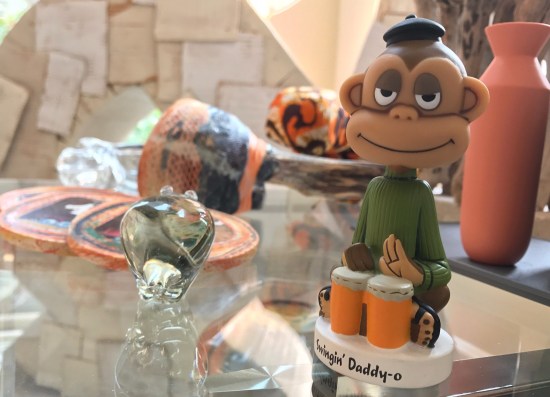
Monkey Beatnik
I learned this tip from a friend.

We were working a book together, at his place, and before we started he turned to a monkey bobblehead on his desk and said, “Ready to go?”

“Are you talking to that monkey,” I asked.

“Of course,” he said, “that monkey helps me out.” He wasn’t even embarrassed about it, he said it like I was stupid for asking.

It turns out that everywhere he works he has a different toy, in his case all of them are monkeys, that he talks to before he starts work and then thanks when he’s done. It’s like he has created a magical creativity token for himself. He gives the monkey credit for the ideas, keeps all the money for himself, and when he’s stuck for ideas he pays attention to the monkey for a bit until an idea comes to him.

He uses all monkeys, but he claims that it works with any toy that has a face.

Here are his steps toward creating your own magic object.

1. Find an object with a face. It doesn’t have to be a toy, it could also be a statue or some other sculpture. Just make sure it has eyes you can look into. If you are religious, you can even use a religious statue of some kind. In fact, the more belief you have in it increases its usefulness.

2. Give the object a prominent spot in your workspace. Somewhere you can see it and reach out and grab it is best.

3. When you start working, acknowledge the object in some way. You can touch it, talk to it or just look at it. Just make sure that this become part of the ritual.

4. Although he didn’t do it in front of me, he also talks to his monkey. If you are stuck, ask your object for the answer. I’m not sure how it answers, we didn’t get into that.

5. Last, and most important, thank it when you’re done. Even if you don’t think your version of the monkey has done anything, thank it. According to my friend, this helps relieve the burden of starting the project again. Instead of having to remember where you were, all you have to do is go back to the monkey and pick up where you left off. This completes the cycle and lets you walk away with no weight on your shoulders.

I haven’t tried this tip yet, but my friend tells me it works wonders. In fact, he says a lot of people do it without realizing it. If you look at artist’s and designer’s workspace, you’ll always find at least one fun object with a place of prominence.

If nothing else, this will give you an excuse to go shopping for toys.
Walking backwards into the future: creativity tip

Creativity is often just a matter of trying to figure out what comes next. We try to figure out where the next brush stroke belongs on the canvas or what word goes next in a sentence.

In a sense, we almost cast ourselves as prophets as we work. When our prophecy is wrong, our next steps strike the audience as cheap or shocking. We change the established rules of our creation and take the audience out of its reality. If the next step is solid, the audience relaxes and extends its trust to you.

One way to increase the reliability of your predictions is to look backwards instead of forward. Look at what you have already done and draw your answers from that.

The simplest illustration of this is to think of a mystery novel. If you reveal on the last page that the killer was someone who you hadn’t previously introduced to the reader, your book is going to be thrown across the room. Obviously, the whole basis of a mystery novel is to make the killer someone who has always been there, but the audience didn’t suspect.

The answer is don’t keep making things up. Look to the past to find out what should happen now. Know that new elements introduced late in the game will never hold the same weight for an audience that the initial elements have.

The next time you get stuck while you’re working, stop looking forward, turn around and see what has already happened. Don’t make up something new, use what you already have. It may seem less creative, but it’s much more satisfying.

Page vs stage: the debate continues

In the world of poetry, there is a large divide between written poetry and poetry intended for performance. Although there are a growing number of poets that see the value of both, performed or “slam” poetry continues to be seen as being of lesser value by many academics and traditional poets. The debate is often referred to as “page versus stage.”

Poetry Foundation is featuring an excellent interview right now with someone who has mastered both, Susan Somers-Willett. Here she discusses what academic poetry might learn from slam poetry:

The academy can learn something crucial from slam: how to put butts in the seats. It’s ironic that, at the same time critics were debating “Can Poetry Matter?” and lamenting the death of poetry for the general reader, slams were starting to emerge across the nation. Slam found poetry’s so-called lost audience, and instead of instructing it to sit quietly, hushed and reverent in the presence of the author, it said to react to the poet—boo, hiss, applaud, give the poem a score of a 10 or a 2.7. Having an actively engaged audience helped the slam grow into what it is today—a series of national competitions that sell out large venues in major U.S. cities.

I think this is an excellent point. Just as there are many types of music, why can’t there be different and equally valuable types of poetry. Classical music has a solid but limited audience, so does academic poetry. Slam poetry engages the audience, makes them feel passionate emotions and lets them know that their reaction to the poem is an important part of the poem. Slam not only puts butts in seats, it makes those butts think and feel. Slam is the rock super-group of the poetry world, capable of filling arenas.

If you have never been to a poetry slam, you should really try it out. Check for a venue close to you by clicking here.

Click here to read the article
Click here to listen to a podcast featuring slam discussion and one of Susan’s poems.

Enthusiasm – possessed by an idea

IMG_8912

Successful creative people have boundless enthusiasm for their work. It gives them pleasure even if it’s difficult or painful. They are swept away in a trance that causes them to deny any doubts they might have about what they are doing.

The word “enthusiast” originally meant a person possessed by a divine being. In other words, a feeling beyond faith or doubt. Being an enthusiast meant becoming one with the object of your belief.

Do you have enthusiasm for your work?

Put yourself aside while you work and literally become possessed by your idea. You will have no doubt because you aren’t discovering something outside yourself, you are just describing what you have momentarily become.

We’ve all heard about characters who take over stories or pieces of wood that tell a sculptor what shape they contain. These are just descriptions of the momentary possession of enthusiasm.

Use your moments of doubt during revision, but during creation be an enthusiast.

How Not To Display Your Art On The Web

Lines and Colors has a great article on displaying your art on the web. Not only is it full of great advice, it also takes the form of an angry sarcastic rant. (So, it’s funny and useful!) Here’s a bit that points out one of my pet peeves about art sites:

Use tiny, square thumbnails with a nondescript crop from some obscure corner of the artwork. You wouldn’t want someone to miss the fun of playing “Concentration” when trying to remember where a particular image is; and if the thumbnails clearly described the images, visitors might actually go to one they like in the eleven seconds they have to look at your site.

Even better, why bother with thumbnails or preview images when clever little dots, squares or enigmatic shapes are so much more artsy? Everybody already knows how cool your stuff is, they’ll certainly take the trouble to click through all the shapes to find an image. Plus if they come back looking for a particular image, they have the fun of discovering all over again!

Also covered are the benefits of having a long complicated domain name and putting everything in frames. This was written by someone who has looked at a lot of art sites and knows their business.

How Not To Display Your Art On The Web

There is always another joke

Jane Espenson is a really successful TV writer with a blog about being a successful TV writer. Her tips range from life-changing lessons to common sense stuff that seems so obvious after she points it out you wonder why you never thought of it yourself. There is one repeated phrase she uses that I think applies to more than just TV writing. Here she explains it:

There is always another joke. This is probably the biggest lesson of comedy writing. No matter how much you love a joke, even if a particular joke was why you decided to write a certain episode, there is always another one.

I think this applies to far more than jokes. There is always another idea. There is always another way things can work. Don’t hold onto something out of fear that nothing will be able to replace it. There is always another way.

She also has a few articles on the process of writing in the “Works” section.

Jane Espenson’s blog

It’s Not Fair. If The Art Can Touch You…

It's not fair, if the art can touch you...

Seattle has the only outdoor sculpture park in America where you are forbidden to touch the sculptures. Which is odd, because some of them are designed to be touched.

If a sculpture is designed to rust and degrade over time, isn’t it possible that letting people touch it might actually improve it? Isn’t art that reacts to its environment supposed to be in that environment?

I thought the sign in the picture was very telling.

Pay attention! For a minute: creativity tip

Screen Shot 2017-08-20 at 8.13.01 AM.png

The New York Times had an article on a man,Christopher DeLaurenti, who recorded the intermissions of classical music concerts. He’s going to release a CD of them and defends them as interesting collections of sound.  To him they are a kind of avant-garde music.

There’s an interesting quote from him when he explains how he sneaked into concerts with recording equipment and escaped detection:

He honed a technique of often shifting his posture and moving around. “Most people are not observant and rarely look at one thing for longer than 10 seconds,” he said.

I know that isn’t a scientific observation, but it strikes me as about right. Most people don’t look or think about any one thing for more than about 10 seconds. In our modern age, bouncing from page to page on the internet, 10 seconds feels like an eternity.

Her is my challenge to you. Every single day find something that you have never paid attention to before and give it a full minute of your time. There’s a lot you can do during that time. Make a list of distinguishing characteristics. Sketch it. Try and figure out the story behind it. Try and imagine what the design team was thinking when they designed it, if it’s human made, or what purpose it serves, if it’s natural.

Don’t let your attention shift to something else until a whole minute has passed. Break that 10 second barrier and give more attention to the world around you. You can unearth amazing things and notice incredible dramas unfolding all around you.

And, if you’re lucky, you’ll notice a guy with a chest full of recording equipment taping an intermission. Don’t stop him though, he’s making music.

Link to Christopher DeLaurenti’s site with free mp3 of an intermission

How Do You Treat Your Tools?

Screen Shot 2017-08-20 at 8.04.18 AM.pngI just finished directing an improvised puppet show which was not only a blast, but also extremely educational.  I thought I might share some of the puppet lessons I learned over the next few weeks.

One of the things I noticed was the different ways the actors treated the puppets. Some of them treated the puppets as if they were real, living creatures. They got special backpacks and bags where they stored the puppets whenever they weren’t in use. They even felt uncomfortable if someone else used their puppet. In fact, words like “creepy” and “wrong” were used when that happened.

The other actors treated the puppets like you might treat a t-shirt. As soon as they were done using their puppet,they slipped it off and they didn’t think about it again until it was time to put it back on. They didn’t care who used it.

I’ve talked to other people about this interesting difference and discovered that the two attitudes extend over every creative art. Some people thought that the actors who were sensitive about their puppets were being overly precious and shouldn’t get that attached. They argued that puppets were only objects.

An equal number of people went in the opposite direction. They said it was only natural to develop that kind of connection.

I don’t think either attitude resulted in a better performance, but I did notice that people were irritated when they were forced to treat the puppets like the other group of people. If someone who treasured their puppet was forced to set it down somewhere unsafe, their eyes would constantly dart to it until they could pick it back up. If someone who treated their puppet like an object was forced to treat it like a person, they felt uncomfortable.

People treat all the supplies they use to create in one of those two ways. They either make their tools into magical implements that must be chosen and treated with the greatest care or they consider only the practical aspects of their tools.

In most books on creativity, they try and push you into treating tools as magical things. They want you to set up a special creative space and a special notebook. This works for some people. Other people work much better just scribbling their notes on napkins and in the margins of books.

Take a moment to figure out how you treat your tools. Recognize the kind of person you are and use that to help you create. My advice is not to tie your ability to your materials. Use the best tools available, but don’t make the lack of a specific tool an excuse to not create.

Treat your tools in the way that is best for you.