If you ever get bored…

If you ever get bored while you’re looking at, reading or listening to something you’ve done, just say to yourself, "You know what would make this good…" Then, whatever you say to finish that sentence, do that instead.

You can also do this during other people’s stuff, but my guess is that they won’t want to listen to you. So, just keep those ideas for yourself.

Creativity tip: do your worst!

Screen Shot 2017-08-20 at 8.22.38 PM

Shooting for the top can be exhausting, why not spend some time settling for the gutter? Instead of trying to write a good story, write the hackiest one you can. Paint something that would make a high school art class shudder with disgust. Shoot for the bottom!

Making bad art on purpose can make you better at what you do. It lets you burn off all the ideas and bad habits you have in a bonfire of mundane crap. You can identify all the mistakes you can make and then, when you make them again, they will be as obvious to you as a giant rabbit dressed as Abraham Lincoln standing in your breakfast cereal. Once you make the worst you possibly can, you can stop yourself from ever doing it again.

I found a great example of this today, cartoonist Anthony Clark was challenged to draw 200 “bad” cartoons and he did. They are fun to read just so you can spot all the different ways comics can be bad. Of course, some of them are really funny as well.

Use your worst to help you get to your best!

link to 200 “bad” cartoons

Short-term heroes

Have you noticed how hard it is to have heroes these days?

It seems like any person you pick to be a hero has a book written about them the following day that reveals a huge list of faults. You know, because we’re all human, even our heroes. Martin Luther King is accused of marital infidelity. John Lennon treated his first wife terribly. Is there anyone left without some black mark on their record?

It’s important to have people to model your life and art after. But, because of shifting standards of acceptable behavior and a media that focuses on digging out dirt, it’s almost impossible to find anyone completely worthy.  Some people go the other direction and get backed into defending their heroes terrible behavior because they admire another part of them. Enough!

Here’s a solution that I’m borrowing from the SubGeniuses. They have a concept called short-term personal saviors.

The idea is to allow yourself to look at someone as a personal hero for as long as you need them and then dismiss them. This acknowledges that people can do worthwhile things while still be humans. No one can hold your heroes against you. It also lets you pick frivolous heroes that might just help you get through a single day or project.

Also, you admire your short-term hero for only one personality trait or action. You can have a hero that you admire just for the way they wrote novels without looking to model their failed marriages and death from alcoholism.

Don’t spend any energy defending your short-term heroes, it’s not worth it. No matter who you pick, you’ll find someone who will tell you why they aren’t worthy.

Pick your hero, use him/her up and move on to the next one. Use the good, dismiss the bad. Think of the advantage you’ll have over people who spend their whole lives looking for a perfect person to have as a hero.

Robert Wilson On Deciding What To Do Next

I watched the documentary Absolute Wilson last night. It follows the creative life of Robert Wilson the avant-garde stage director and writer. It ends with him talking about what to do next and I thought it was interesting enough to pass along:

Sometimes you say to yourself, what should I do next? And people advise you or you decide yourself what to do next. And quite often, you try to think of what is the right thing to do. But, quite often, you should think what is the wrong thing to do. And then do that.

Inspiration for Design and Food

Screen Shot 2017-08-05 at 7.41.51 AM
Today I wanted to share one of my favorite design sites, NotCot. NotCot features an array of reader submitted pictures and stories featuring interesting design. The visual part is the hook, you won’t find any big blocks of text here, just interesting visual after interesting visual. If you want more information, each links to its source. Today, they’re featuring everything from art cars covered in toys to benches made from tennis balls.

Not only that, but they have two other sites with the same basic setup. notcouture.com is their clothing site (which is just getting started and really hasn’t found its feet yet) and tastespotting.com which focuses on food. This is a foodies dream, page after page of luscious food photographs.

If you work in a visual medium NotCot is a great place to start your day and a quick way to keep up with what’s going on.

A James Lipton of your own

lipton071015_198

I was watching Inside the Actors Studio the other day and it struck me that even though its host, James Lipton, is sycophantic to the extreme, it’s certainly not surprising that people want to do his show. After all, people in the public eye are constantly judged, critiqued and have their work diminished. Instead of feeding already huge egos, don’t you think that some of the actors almost look at doing the show as a vacation from their own inner-critic?

We could all use a break like that. I had a thought. Why not make up your own little James Lipton and let him live in your head? You don’t have to talk to  him all the time, maybe you can imagine him a little one room apartment to wait in until you need him. But, when you need him he’ll be there.

At your darkest moment, call him forth. He’ll appear with his stack of cards and list of adjectives to describe how fabulous you actually are. Fantastic! Amazing! SUPER! In fact, your little James Lipton can’t help but think that you are perhaps the most amazing person he has ever met.

And those cards, such information! He has every single thing that you have ever done that he admires. There are things on those cars that you’ve forgotten or might be slightly embarrassed about, but he’s there to make you forget any nervousness. Remember, in his eyes you are fantastic.

While he’s there, you can ask him about anything you’re working on. He will love it. He will think it’s amazing. You have topped yourself!

Then, when you feel your butt has been suitably kissed and your ego stroked, he’ll ask you a few questions and then go back to his little apartment. (What is your favorite curse word? What turns you on?) Then, refreshed and confident you can go back to the harsh realities of the real world.

Right now, my little James Lipton is sitting in his apartment wearing a bathrobe, eating crackers and watching soap operas. He’s waiting until I need him again.

Theory of Obscurity – creating for yourself

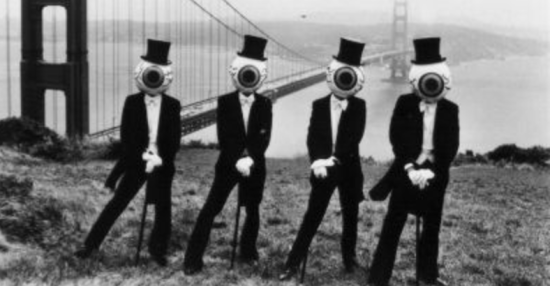
Screen Shot 2017-08-20 at 8.04.49 PMThe Residents may be the world’s most famous unknown band. No one knows who is actually in the band, they disguise their face with giant eyeballs or other disguises, and their music is not designed to appeal to everyone. In fact, it is purposely composed to appeal only to them. They developed their interesting way of looking at the world through the theories of (possibly fictional) Bavarian composer N. Senada. The theory, as stated in this Wired article, goes as follows.

According to this philosophy, artists do their purest work in obscurity, with minimum feedback from any kind of audience. The theory adds that with no audience to consider, artists are free to create work that is true to their own vision.

I bring this to your attention because it led The Residents to try an interesting exercise. They decided for this theory to truly operate, they would have to create music that was not intended to be heard by anyone. They recorded an album that there were going to lock away in a vault until they forgot about it. Eventually, during a dispute with their label, it was released under the name Not Available.

I remember a woman in a poetry class I took years ago. She was so
desperate for an audience and so fearful of a negative reaction that
she would write poems, tear them out of her notebook and abandon them
on park benches and buses. She hoped that someone would find them and
be touched in some way. She would sit in class and cross out negative things in her poems because she was afraid people would like them less.

I was often left wondering what she actually thought because all she wrote was what she thought I wanted to read.

Creating for no audience with the intention of locking something away may be just what you need to spur yourself onwards. If nothing else, forgetting an audience will let you push yourself into areas you might not be comfortable with. It will let you bring up ideas and thoughts that you do not otherwise consider for fear of being judged.

Use the Theory of Obscurity in the spirit in which it is intended. It only matters while you are creating. Afterwards, if someone does see it, it doesn’t compromise the initial process.

Big is Funny, Small is Cute

worlds-smallest-underpants (3)
There is a rule in the novelty industry that you can take an established product and get an entirely new product just by modifying its size to either comically large or super tiny.

The rule says:

Big is funny. Small is cute.

It seems to me that this rule is a good possible initial way to approach any idea that you have. Would it be better bigger or smaller? If you have an established idea, do you get anything interesting by scaling it up or down? It’s also a great way to revitalize an idea that has gone stale.

Of course, I work for the company that produces the World’s Largest Underpants and the World’s Smallest Underpants, so you can see where this rule has taken us.

Let other people’s failures be your inspiration!

There are really two types of inspiration. One is a work of genius so perfect and complete that it inspires you to set your sights higher – to try to make something as good or better. However, there is another, equally important, kind of inspiration. Genius can be overwhelming and scary. If someone else has reached such heights, how could you ever reach them? If so, the second type is for you.

Have you ever seen a movie or read a book so bad you thought to yourself, I could do better than that. Seeing or experiencing something terrible, a horrible artistic failure, can motivate people to try it themselves.

Not only that, but in bad art the mechanics behind it are visible. Reading a terrible mystery novel reveals every trick a mystery writer uses except done sloppily and obviously. It points out so many dead ends, it becomes a road map for doing it correctly.

The next time you are feeling overwhelmed with insecurity, just find a terrible example of what you want to do. Find a bad movie, book or song that actually got produced and released commercially. Then, read, watch or listen to the entire thing.

Obviously, you can do better than that.

Mark Twain Quote On Work and Play

Here’s a great Mark Twain quote about finding out what your "work" is and the dangers of doing someone else’s "work."

What work I have done I have done because it has been play. If it had been work I shouldn’t have done it. Who was it who said, "Blessed is the man who has found his work"? Whoever it was he had the right idea in his mind. Mark you, he says his work–not somebody else’s work. The work that is really a man’s own work is play and not work at all. Cursed is the man who has found some other man’s work and cannot lose it. When we talk about the great workers of the world we really mean the great players of the world. The fellows who groan and sweat under the weary load of toil that they bear never can hope to do anything great. How can they when their souls are in a ferment of revolt against the employment of their hands and brains? The product of slavery, intellectual or physical, can never be great.