Genius or Psychotic? A Look at the Strong Positive Correlation Between Creativity and Psychoses

From Personality Research that attempts to establish a connection between creative thinking and psychoses. Most of the article just defines the terms of the discussion. I think one term discussed in the article is especially useful.

Latent Inhibition (LI) is defined as “the capacity to screen from conscious awareness stimuli previously experienced as irrelevant” (Carson, Peterson, & Higgins, 2003, p. 499).

In other words, a person with a high LI level ignores things they don’t see as relevant, but a person with a low LI level is constantly reevaluating relevancy. Now, they continue, having a low IQ and a low LI level leads to just a small  increase in creative thinking. But, an intelligent person with a low LI level is many times more creative. So, creativity and low LI are seen as two definite factors in human creativity.

They also discuss another study where “fantasy proneness” was matched against diagnosis for mental illness and a definite relationship was found. Here are a few numbers:

…It was found that most (70%) fantasizers, while displaying some signs of psychoses, were able to maintain a normal life.

However, 5 out of the 13 people tested scored more than 2 standard deviations above the mean for schizotypy or hypothetical psychosis proneness, and an amazing 20-35% of all the subjects with fantasy proneness exhibited “significant signs of maladjustment, psychopathology, or deviant ideation. And perhaps a smaller proportion of fantasizers can be aptly characterized as schizotypal or borderline personalities” (Lynn & Rhue, 1988, p. 42). It can be derived from this that at least some degree of overlap exists between healthy creative tendencies and pathological ideational processes.

So, there is according to Jonathan Byrd, a measurable connection.

It seems to me that part of what they should be looking at is not a low LI, but the ability to control LI. Are there ways to make the brain shake loose and start evaluating objects it has previously judged as irrelevant? Are there ways to stop it when it gets out of control?

I’m also interested in the correlation of low LI and fear of failure with psychoses. Creativity seems to be stifled in those that fear the judgment of others, could fear of being judged as crazy actually stifle psychoses?

And, since psychiatric evaluations are completely subjective, do we need to look at changing the definitions? After all, this article could just be proving that most of society finds creative people irritating and wants them drugged and locked away.

In any case, I will be post some exercises in the next few days that will lower you level of LI. Attempt them at your own risk.


Want a gallery show? First step, bathe…

bd37c080831adf22423f5755717726d4--denver-ken-levine
From That Ain’t Art, artist Mat Gleason answers questions about the art world for their readers. His advice is practical. My favorite bit, not quoted below, is that if you want a gallery show, make great art.

Dear Mat,
I am an artist. I feel I am ready for a gallery show, but I have never exhibited before. When I talk to galleries they seem snobby. What can I do?

Bathing and proper hygiene are the first order of business. After that, looking good and being rich cannot hurt too much either. But the reason they seem snobby to you is that you do not know them anymore than they know you. Get to know each other. Get to know the art world.

Click here for the rest.

Liven up your hot dogs!

Screen Shot 2017-08-06 at 8.33.09 PM.png Tired of boring old hot dogs in a bun? The Nippon Meat Packers, an unfortunate translation of a company name especially in the context of manipulating hot dogs, have detailed instructions on how to sculpt them into sharks, flowers or elephants. They’ll still be unhealthy, but they’ll be far more aesthetically pleasing.

pic_winnyThey also have a great corporate mascot. At first I thought he was wearing an astronaut’s helmet, but it’s all just his huge misshapen head.
John K’s Animation Blog

Screen Shot 2017-08-05 at 5.06.59 PM.png
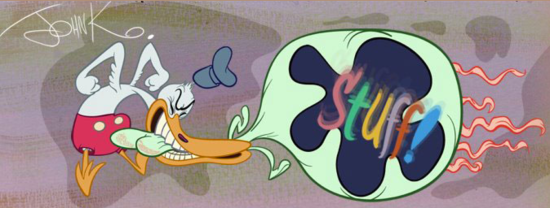
If you are interested in animation or cartooning, I think John K’s All Kinds of Stuff Blog is a must read. John K is the creator of Ren and Stimpy and a kind of animation folk hero for not bending to corporate demands to pump out the bland pap that passes for animation these days.  Not only do you get an inside look at the projects he’s working on, but you also get an intelligent discussion of animation in general. Some of the posts read like a manifesto on what makes a good cartoon. The latest discussion raging on his blog is whether or not cartoonists are the only people who should write cartoons. It all began with this quote:

I firmly believed that cartoonists should write cartoons and had convinced Nickelodeon of it. Not every cartoonist can write of course, but only cartoonists should write cartoons – just as only dancers can “write” (choreograph) dances, musicians can write music and sculptors can “write” sculptures.

Free Movie Scripts? Great if you’re writing a screenplay

This is one of my favorite sites.

main_1-JJ-Abrams-Signed-Star-Wars-The-Force-Awakens-Movie-Script-PSA-COA-PristineAuction.com
Drew’s Script-O-Rama

It links to movie and tv scripts that are available for free on the internet. There are even first drafts and unproduced movies.

My favorites are David Lynch’s Ronnie Rocket and One Saliva Bubble. Two movies no one was willing to make. Not to mention a first draft of a script called The Star Wars.

The Myth of Prodigy and Why it Matters

From APS Observer

What does being a child prodigy mean? Not as much as you might think according to this article which quotes Malcom Gladwell, author of Blink and The Tipping Point and a gifted runner as a child, quite extensively. One interesting distinction it draws is that a child genius is a gifted learner, but an adult genius is a gifted doer.

Early acquisition of skills — which is often what we mean by precocity — may thus be a misleading indicator of later success, said Gladwell. “Sometimes we call a child precocious because they acquire a certain skill quickly, but that skill turns out to be something where speed of acquisition is not at all important. … We don’t say that someone who learned to walk at four months is a better walker than the rest of us. It’s not really a meaningful category.”

So what does lead to success as an adult? The article dismisses Mozart and then points to a better model.

A better poster child for what precociousness really entails, Gladwell hinted, may thus be the famous intellectual late-bloomer, Einstein. Gladwell cited a biographer’s description of the future physicist, who displayed no remarkable native intelligence as a child but whose success seems to have derived from certain habits and personality traits — curiosity, doggedness, determinedness — that are the less glamorous but perhaps more essential components of genius.

Where do you get your ideas? Part three – Alan Moore

v-for-vendetta-1

The question that everybody asks writers is: ‘where do you get your ideas from?’ It seems like a banal question, but it’s the only important question: where do ideas come from? For me, getting into magic was just a way of answering that.

First, there’s nothing there, and then there’s a vague unformed idea in the mind of the artist or writer. Then the idea takes on a little more form, and then, suddenly, it’s a finished script or a finished drawing. Something has come into being out of nothing. It’s the rabbit from the hat. That to me is the definition of magic. It covers a lot of other ground in that everything anyone has ever said about magic is true, it’s a very rich landscape to explore and it certainly has an effect in some way or another on everything that I do.

Alan Moore

Create a Digital Archive of Your Entire Life

Screen Shot 2017-08-06 at 8.18.31 PM
A Digital Life – New systems may allow people to record everything they see and hear — and even things they cannot sense–and to store all these data in a personal digital archive

Microsoft is looking a way for you to record every second of your life. It’s called MyLIfeBits. Gordon Bell has already been recording every moment of his life for 6 years. The system is imperfect, but he has already amassed:

…a digital archive of more than 300,000 records, taking up about 150 gigabytes of memory. The information is stored on Bell’s dual-disk notebook computer and his assistant’s desktop PC, which are backed up locally and off-site. Video files grab the lion’s share of the storage space–more than 60 gigabytes–whereas images take up 25 gigabytes and audio files (mostly music) occupy 18 gigabytes. The remainder is shared by 100,000 Web pages, 100,000 e-mails, 15,000 text files, 2,000 PowerPoint files, and so on. Bell has found the system particularly useful for contacting old acquaintances and finding other people with whom he needs to communicate. He has also employed MyLifeBits to retrieve Web sites for citations in his research papers, to provide doctors with records of a 25-year-old coronary bypass, and to obtain a photograph of a deceased friend for a newspaper obituary.

They imagine a day in the life of a fictional family that uses the technology:

Because most of their information is available via secure Web access, the family members can retrieve it anywhere and at any time. Particularly sensitive information that might put someone in legal jeopardy can be kept in an offshore data storage account–a “Swiss data bank,” if you will–to place it beyond the reach of U.S. courts. The children in the family can encrypt their recordings, but the LifeBits service will give the parents access to the data in case of an emergency. Likewise, some of the parents’ digital memories may be covered by employment contracts that stipulate that the data related to their jobs belong to their employers. When such employees leave their jobs, they may have to perform a “partial lobotomy” on their copies of the memories, expunging everything deemed to be company property.

Now, bypassing the privacy issues, imagine handing over the security of your childhood memories to Microsoft, and the enormous dread the thought of this gives me, doesn’t it seem like a technology like this will do away with storytelling? Listening to a great storyteller is leaving the idea of literal truth behind. Hearing people describe what has happened to them, from their perspective, is one of the great joys of life. Exaggeration. Misunderstanding. Lies. These are very human things.

Communicating perspective is the cornerstone of art. In the future, instead of listening to a fantastic story of your friends night out, you’ll be forced to sit through an 8 hour tape of the entire boring ordeal.

I don’t care if this technology exists as long as I don’t have to use it. The loss of humanity far outweighs the benefits of remembering tiny details. In fact, I’m going to go purge the history in my browser right now, just to prove a point.

Ken Robinson – Learning to Be Creative

From David Shenk’s Genius Blog

Here are excerpts from a talk Ken Robinson gave at a conference. I had never heard of him before this, but I think I’m going to pick up his book, Out of our Minds, Learning to be Creative. The improvisers will notice the similarity to Keith Johnstone. A few choice quotes:

If you are not prepared to be wrong, you will never come up with anything original.

All kids have tremendous talents, and we squander them pretty ruthlessly.

Kids will take a chance…By the time they get to be adults, most kids have lost that capacity. They have become frightened of being wrong. [We stigmatize mistakes.] We’re now running national education systems where mistakes are the worst thing you can make. The result is that we are educating people out of their creative capacities. Picasso once said that all people are born artists, and the problem is to remain an artist as we grow up. I believe this passionately, that we don’t grow into creativity, we grow out of it, or rather we get educated out of it.

Our education system is predicated on the idea of academic ability. The whole system was invented around the world to meet the needs of industrialism…So you were steered benignly away from things at school when you were a kid, things you liked, on the grounds that you would never get a job doing that. Isn’t that right? Don’t do music, you’re not going to be a musician. Don’t do art, you’re not going to be an artist. Benign advice — now profoundly mistaken.