
Cartoon via We The Robots
Cartoon via We The Robots
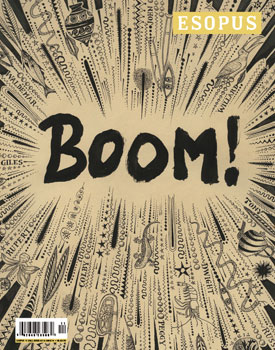
Esopus is more than a magazine, each issue is a work of art. The “articles” in the magazine are actually pages turned over to a different artist to do whatever they like with. From found beauty to pages from sketch journals to movie scripts and photographs, it’s packed full of fantastic stuff. The design of the magazine and presentation is as impressive as the material it contains.
I got latest issue in the mail today and was inspired to write about it because it has a “can’t miss” section. 24 scanned pages from a journal a soldier kept in a German POW camp. 2nd Lieut Gerald Limon drew cartoons, recorded the lyrics of songs written in camp and kept a detailed list of what books he read while he was there. Beautiful, heart wrenching and completely inspirational.
The price for subscribing might seem high ($18) for a magazine that only comes out twice a year, but they actually subsidize with donations and sell it at less than cost because they want to reach a wider audience. It’s non-profit, which means no ads and no one to answer to.
Did I mention that it comes with a CD of music? This month it’s songs inspired by dreams that readers sent in. Did I mention that there are removable pieces and foldouts? This month, there’s a pocket page that holds a reproduction of an old handwriting exercise book that has been subtly modified by an artist.
I love it. This is their site. I give it my complete and unpaid endorsement.
Bill Watterson, creator of Calvin and Hobbes, gave a commencement address at Kenyon College in 1990. He made some interesting comments on creativity and the creative life. I thought the most interesting section was his comment on how to recharge your brain.
It’s surprising how hard we’ll work when the work is done just for ourselves. And with all due respect to John Stuart Mill, maybe utilitarianism is overrated. If I’ve learned one thing from being a cartoonist, it’s how important playing is to creativity and happiness. My job is essentially to come up with 365 ideas a year.
If you ever want to find out just how uninteresting you really are, get a job where the quality and frequency of your thoughts determine your livelihood. I’ve found that the only way I can keep writing every day, year after year, is to let my mind wander into new territories. To do that, I’ve had to cultivate a kind of mental playfulness.
We’re not really taught how to recreate constructively. We need to do more than find diversions; we need to restore and expand ourselves. Our idea of relaxing is all too often to plop down in front of the television set and let its pandering idiocy liquefy our brains. Shutting off the thought process is not rejuvenating; the mind is like a car battery-it recharges by running.
Money Magazine recently featured an interesting article on creativity. The author suggests that since American can no longer compete when it comes to manufacturing the least expensively produced products in the world, we should change our focus to creativity and innovation.
He points to Google as an example. After all, Google produces so many products, so quickly, it’s impossible to keep up with them. Don’t all the best companies have legions of fans waiting to see what they do next?
I agree with him. Gone are the days when one good idea is enough to build and maintain a fortune or a company can exist that sells a single product unchanged for decades and remain a market leader. Shouldn’t the question always be, “What’s next?”
What he implies, but doesn’t say, in the article is that most companies don’t just not value creativity, they despise it. They focus all their energies on solving momentary problems (putting out fires), refining their hierarchical structure and worrying about why customers aren’t as interested as they used to be. Not to mention that they have to be tricked into learning about creativity by consulting companies who call it “management techniques.”
Creativity is change. Change is scary. Change is something businesses only want when they are in deep trouble.
That said, the business I work for premiered the Electronic Yodelling Pickle today, which Nerd Approved declared to be “The Product Of The Century.”
Google should be very afraid.
This may seem like a silly tip, but I swear it works.
Give yourself a secret nickname. This is going to be like your super-hero identity for creativity. For instance, perhaps you could call yourself “Genius Pants.” Now, when you need an idea fast or you start to get stuck, just say to yourself, “What now, Genius Pants?”
Once you do this, it activates a whole other part of yourself. The part of you that is energetic and eager to please. The part that is brimming with ideas! Great ideas!
Then, after you’re finished, just say, “Thanks Genius Pants, you are awesome.”
The first step is to choose your nickname. I recommend having more than one word in your nickname. The first word can either be a positive adjective, like “genius” or “amazing,” or a title of some kind, like “princess” or “mister.” Then, the second word can be any noun or another positive adjective.
It can also be fun to add a “Mc” to the front of the second word.
Here are a few samples:
Princess McSparkles
Magic Racecar
Sergeant Playmobilecastle
Kid Genius
Awesome Sequins
Colonel Jellybean
Rebellious McCupcake
Pick a stupid name, but a name you like. Don’t tell anyone. Sharing it will make it work less. It’s a nickname for you to use for yourself.
If you come up with one that you aren’t going to use, just leave it in a comment. You might be helping someone else.
I came across a quote from Flannery O’Connor that inspired this post. She said, “The writer should never be ashamed of staring. There is nothing that does not require his attention.”
I don’t think this applies to just writers, but creative people in general. It’s only through close examination that you can get past the surface and figure our what’s really going on inside of anything. This sometimes requires us to look at someone a little bit too long or to pay too much attention to a conversation at the table next to us. We might ask our friends questions that seem too probing or they catch us going through the mail they left out on the table.
Society might judge us rude, but this observation is crucial.
Don’t be ashamed of noticing the world around you. Stare, listen and ask questions. Sometimes you’ll get caught and confronted, but this won’t happen often. Don’t give it a second thought. Drink in the world in loud, gigantic gulps.
Stare proudly. The information you take in is the fuel for what you produce.
 I’ve been reading about Nikola Tesla for the last couple of days. Tesla was a brilliant inventor that had flashes of insight so intense that plans for his inventions appeared whole in his head at once in every detail. Tesla and Thomas Edison were bitter enemies and I came across a Tesla quote that helps to define the difference between them.
Edison famously said, “Genius is one percent inspiration and ninety-nine percent perspiration.”
Tesla’s response, recalling the time he spent working for Edison, was, “If Edison had a needle to find in a haystack, he would proceed at once with the diligence of the bee to examine straw after straw until he found the object of his search. I was a sorry witness of such doings, knowing that a little theory and calculation would have saved him ninety percent of his labor.”
Edison was of his age, approaching the problems of the world as a laborer. Tesla was more of our age, creating ideas easily and watching them spread… or not.
Here’s another quote of Tesla’s, “The practical success of an idea, irrespective of its inherent merit, is dependent on the attitude of the contemporaries. If timely it is quickly adopted; if not, it is apt to fare like a sprout lured out of the ground by warm sunshine, only to be injured and retarded in its growth by the succeeding frost.”
Edison understood what people wanted and worked on that. Tesla was a fountain of ideas, but he had no idea what people would accept.
Another interesting distinction in creativity and marketing.
The Twin City Daily Planet posted an article by Michael Fallon, one of their critics, called How creativity is killing the culture. In it, he suggests that encouraging everyone to be creative has resulted in “a nation of navel-gazing dreamy-eyed so-called creatives who no longer
consider it worthwhile to roll up their sleeves and get down to hard
work to get a job done, or, even worse, who no longer deem it worth
their time to bother checking out any of the stuff that anyone else has
made.”
Obviously part of the point of the article is to start discussion (flamebait) more than I think he’s really serious. In truth, it seems like he’s burned out with his job and is tired of going to gallery shows by bad artists.
The meat of his argument is that people shouldn’t show bad art to an audience. Two hundred years ago, most of the creativity you would come in contact with was probably pretty bad. The art you would see and the music you heard was produced by local artists. Only the great art survived, so it seems as if they were better than now. Then, when performances could be recorded and art more easily distributed, there was a time when a very select group of editors and writers decided what was good and what should be seen. Now, the role of the critic is being diminished in value and that probably hurts if you’re a critic.
Today, you have access to music and movies that would never have made it to mass distribution even twenty years ago. Is there a lot of bad stuff? Of course. I haven’t seen an increase in the number of bad gallery shows here in Seattle, but the competition has increased.
I agree with him that I see a trend amongst creative types to not pay attention to what is being created by others. Great writers read, great chefs eat at other restaurants, great musicians listen to music, if you aren’t an avid consumer of something, why would assume that you would be able to create it?
But, I say if you get pleasure from creating, by all means create – just don’t assume you’re producing something of interest to others. If you do want to share it, be prepared to be ignored. Even if you produce something great, be prepared to be ignored or dismissed. So has it been, so shall it be.
The rush to creativity has increased the amount of art produced, but I don’t think the percentages of good to bad art has changed. There is more good art, there is more bad art. That means critics have a numerically larger number of artists trying to get reviewed and a larger number of bad artists.
I’m going to include one more paragraph that to me seems to describe the way the world has always been. There was no magical time of fantastic art in the past. It has always been extremely easy to create something and extremely difficult to create something great.
From my vantage point, the zero-sum creativity spiral has some
strangely counterintuitive and dreadfully harmful results. Most
worrisome among these is the fact that the constant lip service to
creativity leads to the creation of more and more stuff—art and music
and writing and the like—that is actually not very creative,
uninteresting, of poor quality, and off-putting to any potential
audience. This may seem an impossible thing to stem from such a
feel-good sentiment—more creativity must mean a better world,
right?—but the problem is that more emphasis on creativity means less
emphasis on what it is precisely that makes art good. It’s not the
simple act of making—of creating something, anything—that makes art.
It’s the application of craft, dedicated practice, careful thought,
hard work, and artfulness that makes art. Real creative art is a rare
and precious thing and this will likely always be so.
I guess, to him, it would be better to discourage creativity. That way, he would have far fewer artists to deal with.
Just a quick post.
Here’s a random simile generator! Just press a button and try to justify what it says.
Joy is like a swimming pool?
Jealousy is like a calculator?
Frustration is like a parking lot?
Well, that last one is kind of easy, but still…
Kurt Vonnegut’s answer when he was asked, "Were do you get your ideas?"
Where do I get my ideas from? You might as well have asked that of Beethoven. He was goofing around in Germany like everybody else, and all of a sudden this stuff came gushing out of him.
It was music.
I was goofing around like everybody else in Indiana, and all of a sudden stuff came gushing out.
It was disgust with civilization.
Quote via devilduck
 Creative Creativity