Ignorance can be Creative

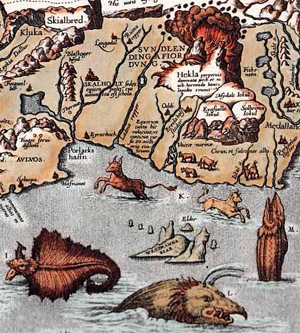
Dragons
It’s always good to work at the top of your intelligence and do research when you need to, but doesn’t ignorance spur creativity?

Doesn’t some of your best stuff come from trying to figure things out?

Explore what you don’t know, what you don’t understand and don’t be afraid to make things up.

Emotional complexity is interesting. Not knowing how you feel about something before you start is riskier, but also potentially richer.

At its best, creative stuff creates a map to uncharted territory – an attempt to describe ignorance. Whether its finding a new solution to a problem at work or painting a masterpiece, it’s at once totally new but it also makes complete sense.

Most people are scared of ignorance. Think about old maps, whenever there was an unexplored area of the map it would be labelled “here be dragons.” They just projected all the fear and anger and everything terrifying projected onto the unknown. That’s how people treat the unexplored territories in their own heads. Dragons are lurking around every corner.

It’s the artists job to brave the dragons and try and describe what is actually there. Instead of fearing your own ignorance, get excited every time you find one of these areas. Move boldly into it and explore.

That doesn’t mean what you’ll produce is scary, a comic strip like Calvin and Hobbes and Peanuts (at its height) faced the unknown as squarely as Death of a Salesman or Hamlet.

Ignorance may be bliss to some, but to us, it’s just potential genius!
Love your ideas

Screen Shot 2017-08-05 at 9.06.15 AM

Do you love your ideas?

Sure, you love your good ideas and the ideas that make you money and the ideas that make you laugh, but do you love all your ideas?

Whatever that mysterious force inside us is that lets us connect things together in a way they never have been before, well, that force doesn’t know if an idea is good or not. It just pumps out idea after idea, spraying them all over the place in an endless geyser.

The only way to stop this force is to tell it it’s doing a bad job. To tell it that it’s not making sense and couldn’t it come up with something more useful?

It doesn’t even have to be you saying it, someone else telling you that your idea is stupid can do it. In fact, hearing someone else being told their idea is stupid can shut it off if you aren’t careful.

When that happens the geyser dries up and we find ourselves begging it to start back up again. We just need an idea, any idea, but all we get is a bunch of dust and nothing.

Here’s a way to get around that.

Love every idea you have for just a moment. No matter how silly, stupid or how many copyrights it breaks, just smile and enjoy your idea before you let it go.

I’m not saying that you have to pretend it’s a good idea, just that you enjoy it. Smile it at it. If it’s good, write it down or say it out loud. If it’s bad, just enjoy it like you would a bad movie or a child’s joke.

Every idea thinks it deserves to be enjoyed and loved.

In fact, why not go one step further than just enjoying the idea and actually add to the bad idea. If it occurs to you that the mechanical horses in front of grocery stores should be transformed into highway-ready ecologically friendly vehicles, don’t toss it aside as unworkable. Instead, start designing a way to hold all the rolls of quarters you’re going to need to get to work and back.

Let your ideas start to get connected, then you won’t have to release them. They become part of a web to build a better idea. Instead of throwing things away, you’re using them as a foundation for something else.

Appreciate, smile, enjoy and cherish every single idea you have. Just don’t act on all of them.

Do this and they’ll keep coming.

In fact, you’ll have so many ideas they might start to get irritating.

Not to you, but to all the jealous people around you who struggle to have any idea, even a bad one.

Increase your creativity by making fewer choices


Some people who want to be considered creative spend a lot of time focussed on making every single aspect of their life reflects their creativity. It’s not enough that they are a brilliant painter, they also have to wear crazy outfits and drive around in a car with jewels and feathers hot glued to the outside. Here’s a thought, have you ever tried being completely uncreative in the parts of your life that don’t directly impact your work?

Lots of artists talk about the importance of routine and discipline for their work, but there is also power in making a choice once and sticking with it.

I was reminded of this when I read an article about Devo asking to meet David Lynch. Lynch agreed, but the meeting had to be at Bob’s Big Boy. You see, Lynch ate lunch there every day. This is how Lynch describes it:

I like things to be orderly. For seven years I ate at Bob’s Big Boy. I would go at 2:30, after the lunch rush. I ate a chocolate shake and four, five, six, seven cups of coffee–with lots of sugar. And there’s lots of sugar in that chocolate shake. It’s a thick shake. In a silver goblet. I would get a rush from all this sugar, and I would get so many ideas! I would write them on these napkins. It was like I had a desk with paper. All I had to do was remember to bring my pen, but a waitress would give me one if I remembered to return it at the end of my stay. I got a lot of ideas at Bob’s.

Charles Schulz, creator of the Peanuts comic strip had the same breakfast, english muffin with grape jelly, and lunch, tuna salad, every day at a diner he built for himself.

Einstein famously didn’t like to think about his clothes and wore the same outfit every day. He said, “I like neither new clothes nor new kinds of food.”

Obviously this doesn’t work for everyone, most people find their creative lives enriched by new experiences. However, spend a few minutes looking at your own life. Is there a decision you dread? A process that takes up too much of your life? Try simplifying it.

Eat the same lunch every day, get your hair cut on the same day every month or stop worrying about the color of your socks. Whatever weighs on you, take control of it!

You just might find that spending less time on the trivial gives your more time for the amazing!

(Read more about David Lynch’s creative life in Catching the Big Fish his book on meditation and creativity. It’s on sale for $5.99 on Amazon and it’s a bargain.)

Stealing creativity strategies from businesses

Inc. Magazine has an interesting article on developing and maintaining corporate creativity. It’s worth reading and there are a couple of interesting points that I thought applied to individuals as well.

Provide Lots of Free Time to Think

BrightHouse’s 18 staff members get five Your Days, in which they are encouraged to visit a spot conducive to reflection and let their neurons rip. No mandate to solve a particular problem. Just blue-sky thinking — often under actual blue skies. Reiman believes this unstructured cogitation is just as important to a project’s success as time spent hunkered down in client meetings. Or as he puts it: “I think; terefore, I am valuable.”

Do you give yourself time to think? It’s one thing to blame your work or depend on your work for thinking time, but you aren’t going to get it at most jobs. If time to think doesn’t seem to occur naturally, you are going to have to schedule it.

Bring in Outsiders

Many top innovation firms tap the perspectives of outside experts — be they physicists, poets, actors, archaeologists, theologians, or astronauts. At BrightHouse, such distinguished professionals, otherwise known as “luminaries,” are constantly cycling through the office.

Is your creativity insular? Do you look for help when you need it? Do you guess at things instead of asking? Learn to use other people for your own creative purposes. It’s not at all selfish, most people can’t wait for a chance to share what they know and will eagerly supply with everything you need. Find someone with information relevant to your current project and use them!

Do it for Free

Creative folks enjoy applying their talents to noble causes — and, increasingly, their employers keep them happy by providing opportunities to do so. At BrightHouse, employees with great ideas for improving public life receive a $1,000 bonus on the spot.

So many people complain that they aren’t paid for their creativity. Have you looked for a way to benefit others for free? This is a great way to get exposure and increase your skills while improving the world. Don’t wait for a paycheck to do the things you love, find an outlet that appreciates what you have to offer. The money will come eventually.

Read the article here.

Link via Dose of Creativity

Ira Glass on the Motivation to Create

Ira Glass, host of This American Life on NPR, points out that most creative people start out trying to produce amazing things in a medium they love. They also start out with a high taste level. Their initial product does not live up to that high taste level, they know it’s not good. Most people never get past the point of producing things that don’t live up to their own judgement. How do you keep going until what you produce is actually good enough to please even you?

You can watch the whole series of Ira Glass on storytelling here.

Great video that will help you through difficult times.

Eliminate other people’s imagination

Nick Mamatas, controversial writer and editor, was asked by someone whether or not they had the potential to be a great writer. He posted his answer and it’s a fascinating discussion of good versus great, the value of practice and turning on the pilot light of imagination.

The whole answer is worth reading and debating, but I wanted to point out one particular bit because I think it has a universal truth that applies to all creative work.

The goal of the practice is to negate the negation — to eliminate the use of other people’s imaginations instead of your own. You must negate and negate and negate until there is nothing left but you, your right hand, and that woodchipper. Do you think it is clever and responsible to find “balance” in your life by keeping a day job and writing every other weekend? You should cultivate a loathing for yourself, for such advice, and for the pathetic circumstances of existence — bills and kids and private property, that makes that advice seem so sound. Do you think “real artists” run around from lover to lover, living off the fat of the land and friendly patrons one might meet in midnight cafes? Embrace the reality that you are a hopeless poseur playacting the neuroses of a couple prominent writers and zillion awful pigs from the last century. All that has come before is worthless, except for those few people you realize were using their own imaginations and not the mass imagination, and their work.

As you can see, Mamatas is not out to make any friends. Even if you disagree with him, what he says is worth thinking about. How much of what you do is just you? How much is just everything that came before you projected on to you? What do you need to do to grind away the inessential, unoriginal parts of your creativity?

By the way, I just read Nick’s book Under My Roof and thought it was great. Also, his submission guidelines for Clarkesworld are extremely funny.

Link to answer

Turning your commute into art

My buddy Gibson, designer of the Avenging Narwhal, has a history of interesting projects. Last Friday he sprang another one on us. I’ve talked before about the power of changing your commute, but Gibson managed to make his commute a creative act. He walked the 16 miles from his house to the office instead of driving. How does that change the experience of a commute? What details do you notice. Below is the email he sent me last Friday immediately after completing the event.

In My Day

Performance Art Project by Gibson Holub

Today I walked to work. 16 miles.

I left at 3:45 AM from my house in Seattle and headed up Hwy 99.

Screen Shot 2017-08-05 at 7.49.24 PM

The sky was clear. The moon was half empty. I was armed with pepper spray.

There aren’t many people out at 3:45 AM on a Friday, just a lot of cops and cabs.

I saw the first glow begin on the horizon at 4:30.

My feet started hurting at about 5.

I arrived at Accoutrements in Mukilteo at 8:42 AM.

So door to door, it took me 4 hours & 57 minutes.

That makes my walking speed 3.23 mph.

I went through 41 stop lights (or somewhere close to that, as I was a bit groggy).

Screen Shot 2017-08-05 at 7.50.23 PM.png

I wore a pedometer. When I arrived it read 32,308 steps.

I recorded the event with some photos. I took a picture of myself every 15 minutes or so.

I’m currently experiencing some serious discomfort in my legs.

I think I’ll pull the shoelaces out of my shoes and frame them.

Screen Shot 2017-08-05 at 7.51.05 PM

Artist’s Statement: The Search For Meaning

Why did I do it?

I did it because it was absurd. I did it because it was liberating. I did it because I knew it would be challenging.

I did it because I’m inspired by the unexpected, the unannounced and the completely unnecessary.

Is it art? Who knows, but I walked 16 miles to work today for no reason and it made me feel alive.

Screen Shot 2017-08-05 at 7.52.07 PM

More pictures here and here.

Start with projects you can complete

Warren Ellis, novelist and comic writer, wrote a great post about the best way to complete a project that people will want to consume. He frames it around Joss Whedon’s Dr. Horrible web project

Part of his point is that you have to earn people’s trust before they will pay attention to something big. Instead of starting with a huge epic or a full length feature, start with something small and manageable and build.

The three strongest points he makes are, “Be Short, Be Bold and Get It Done.” Later in the article he adds, “Be Great.”

He adds:

I can’t tell you how many new hopeful comics writers I meet who have never finished anything in their lives because their intended first project is a hundred-episode epic that creates a whole new universe or three. And I tell them all the same thing: you’re screwed. No-one will want it. Not until you’ve written something short, capable of being produced on a budget, and finished. Your epic may be worldchanging, but no-one will ever know because no publisher will gamble that kind of money on an unknown. And that’s before you get to the vagaries of the attention economy.

I think this is fantastic advice, especially with web content. I know people who won’t even start a video on youtube if the length is over five minutes. Produce enough brief, memorable stuff and people will flock to your longer, more complex stuff. Build an audience, create desire with tiny savory snacks before you serve up a meal.

Also, limitations can be a powerful way to inspire yourself. Challenge yourself to Be Brief, Be Bold and Get It Done!

Read the whole article here

Argument for simplicity

Copyblogger posted a quote from John Caples, one of the great ad men in history. He wrote, in 1932:

Don’t make ads simple because you think people are low in intelligence. Some are smart and some are not smart. The point is that people are thinking about other things when they see your ad. Your ad does not get their full attention or intelligence. Your ad gets only a fraction of their intelligence . . . . People won’t study your ad carefully. They can’t be bothered. And so you have to make your ads simple.

While this quote is intended to aid commerce, I think it has uses for art as well. I’m not saying all art should be simple, but I think this quote makes a good case for at least an appearance or layer of simplicity that will allow someone to get something from it without their full attention.

If you are creating something that you want to be read or viewed by a large number of people, especially if it’s intended for the web, it needs to be graspable without someone’s full attention. The competition is fierce and you’re lucky if someone is paying even 25% attention when they look at something you’ve created. The complexity can be there, under the surface, to reward the people who decide to look deeper, but they must have a reason to look.

There are lots of places this doesn’t apply, but I thought it was an interesting idea. Don’t dumb it down, just simplify.

Playing the media like an instrument

Joey Skaggs is an artist, but his medium isn’t painting or poetry, he uses the media to create huge projects. You see, he creates pranks. He changes the world and people’s perceptions of reality by putting fake information into the machine that has been set up to show us reality. His point, that what the media reports needs to be questioned, is obvious, but his pranks are clever.

He has a list of all of his pranks on his site, but some of his more memorable ones include a cathouse for dogs (a doggy prostitution ring) and vitamin pills made from cockroaches. Both of these received huge media attention and his fake cathouse for dogs almost got him arrested after it was reported on ABC news.

While I was looking through his site, I came across a great essay he wrote on how to play the media. If you ever have to deal with the media, the advice in this piece will help you put yourself in control. Or, you can just use it to pull your own prank.

ANGLING FOR THE JOURNALIST
Concoct a well thought-out story. TV news producers, writers and reporters are greatly under the influence of Hollywood. Hollywood is equally influenced by what appears in the news. Our culture is reflected in both of these forms of media. So it’s important to combine the necessary theatrical elements to attract them. In essence, give them what they want!

Dangling the line:
You may select from any of the following hooks, lures, and tasty baits. Mix and match for a formula that is sure to work.

Dependable hooks:

Sex
Controversy
Power
Sensationalism
Exploitation
Heroism
New technologies
Betrayal
Revenge
Incompetence
Faith
Little guy against the system
Wealth
Determination
Anything with an animal or a child

The whole article.

In any case, all of the articles on his site are an interesting glimpse into how the media works and how you can take advantage of it. It’s not easy. He points out that faking a business actually requires more work than actually having a business.

For me, it made me realize how many different mediums there are for us to apply our creativity to. Even if you can’t change the world to be the way you want it, maybe you can get the media to report that it’s that way.